The study of exoplanets has been a focus of scientists and astronomers for years, whether it has been for merely understanding the surrounding solar systems or for finding another planet such as ours. A planet that could host the human race one day or a planet that could already be the home of intelligent life forms.
But looking for such planets is a long and tenuous road, and the discoveries on the way may find their worth in equally amazing results. We may not be finding life or homes, but instead, we are finding secrets of how the universe works, how it was formed and maybe even how we came to be.
On that note, an international group of astronomers has recently completed the mapping of the surface of a very peculiar exoplanet. Named 55 Cancri e, this particular exoplanet was the topic of scientific discussion recently after the Hubble Space Telescope was able to study the composition of its atmosphere through a new method of observation and analysis.
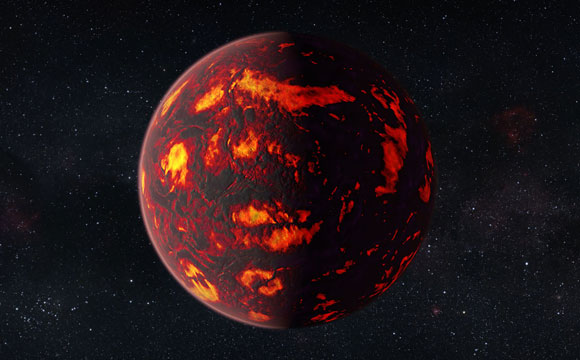
Now, it will make an even better topic of discussion as while the researchers were keeping their eyes on it, they noticed something astounding. Starting with the readings that described a very high margin of temperature swings on the surface of 55 Cancri e, scientists soon realized that this constant see-saw of heat has led the planet of developing a two-faced feature. One half of the planet is almost completely solid while the other half is nearly completely buried in lava. As a result, the hot side can score temperatures up to 2,500 degrees Celsius (roughly 4,500 Fahrenheit) while the cool side only goes as far as 1,100 degrees Celsius (2,000 Fahrenheit).
A year on 55 Cancri e lasts only 18 hours. One half is always facing the star it orbits, similarly to how the Moon does around our own Earth. While the scorched face of this exoplanet has lost any traces of an atmosphere, scientists believe that the ‘cool’ side may still detain traces, despite its still hot temperatures. Researchers mentioned that the loss of its atmosphere may have been determined by the fact that heat is never being efficiently transferred from the scorched face and into the other one.
55 Cancri e remains one very exciting starting point of study for astronomers as it’s one of the closest exoplanets to our solar system, making its observation a little less difficult.
Image Source: 1