The news coming from New Horizons may soon subside but in the meantime, we can still be thankful for snippets of information such as the one supporting the idea that the chasms of Charon suggest a former subsurface ocean. The discovery was made thanks to LORRI – the Long Range Reconnaissance Imager onboard the New Horizons craft that has just several months ago passed by Pluto and its moons.
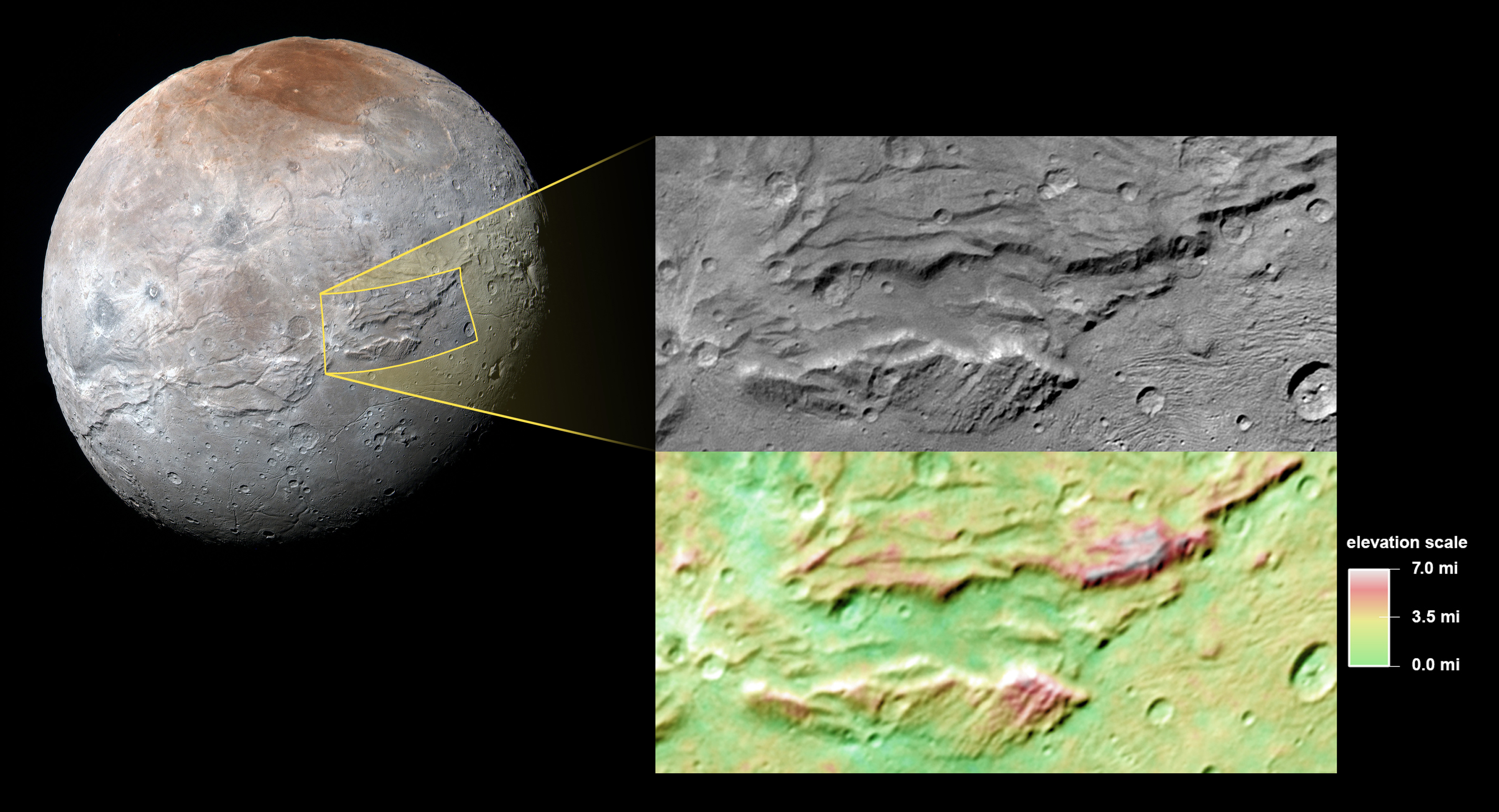
The photos that the probe managed to shoot when passing Charon – the largest moon of Pluto’s total of five – depict a lot of terrain signs that suggest the existence of a subsurface ocean that, at one point, froze over and expanded outward into becoming the jagged exterior that can be spotted these days. Across the equatorial belt of Charon, there are numerous chasms and fractures that are, at times, as long as 1,100 miles and 4.5 miles deep.
If the theory that suggests that is true, it would explain the simple phenomenon that would have taken place to create Charon’s stretched out surface. The theory is that as a result of the formation process and radioactive decay of elements, there could’ve been at one point enough internal heat to melt underground water ice. This, instead, would have turned into a subsurface ocean that, as temperatures started dropping again, turned frozen solid and expanded outward.
The photos taken by New Horizons was able to immortalize the nature of Charon’s terrain, but not so much study its composition. However, in terms of the topography of Charon, the probe noticed a huge amount of chasms, similar to what a canyon looks like. The studied images would suggest that the elevation in those fractures and canyons reach as much as 7 miles altitude, although that value is the absolute maximum found so far on the surface of Charon.
Serenity Chasma, the name of the equatorial portion of Charon that was captured in the photos taken by New Horizons is one of the most easily visible portions of the moon that suggests the existence of a subsurface ocean a long time ago. The pictures were taken from a distance of 78,700 km and approximately an hour and 40 minutes before the probe came closest to Charon in its trek.
Image Source: 1