Google’s previous Chromebook Pixel represented an amazing model of laptops. But, they were extremely expensive too — so costly that they became the laughing stock for technical specialists. Now Google is offering us the new model Chromebook Pixel, and what do you know: this is a better, less costly and so tempting laptop for a passionate fan.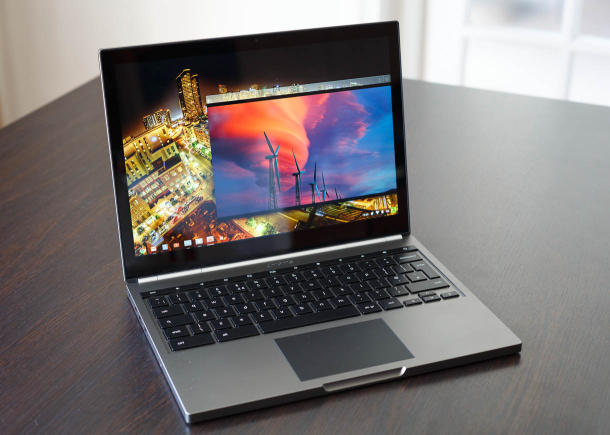
General Design
We could say that this piece of technology is stunning, but not in the sense that you would expect. Just like its previous versions, Chromebook Pixel is an incredibly simple gadget of steel with essentially no marketing anywhere.
Instead of its logo, Pixel has small little bars of vibrant lighting along the edges of the lids, and small marks that are labeled with “chrome” on a very minimalist hinge.
However, make no error regarding this type of easy to use gadgets: the Chromebook is not something you can call “fragile”. The thicker and squared model is made in a very obvious way that places it apart from the teardrop design of similar products.
Chromebook Pixel is a rather rough looking, but still handsome piece of engineering, a laptop that is satisfied to have a little extra weight if this means enough space for USB slots.
Speaking of slots, you will discover on it elegant Type-C USB slots on each of the sides — the same type that you can see on the newly released MacBooks. These little details make a big difference: if you have not found out, Type-C USB represents the future of ports, connecting almost everything on the market.
Like a traditional USB slot that is incorporated on every gadget, the Type-C can take care of energy and information, but in an improved way. It is as quick as the USB 3.0, but it can be also used to charge the computer instead of powering only peripheral gadgets.
Technical Specifications
Pixel, basically, is the Chromebook concept in its ideal type: this is a completely developed, very attractive device with a resolution of 2560 x 1700 assuring high quality display for the touch screen, 8 GB of RAM with an i5 Intel Core processor from the fifth generation, all of them on an affordable platform under 1,000 dollars.
For those who are willing to pay more, there is also a $1,300 edition (Pixel’s initial starting point) that has incorporated the i7 version and 16 GB of RAM on it. Both of these products are available from now on in Google’s online store and they seem to be a great offer for a device that is mainly an Internet browser.

Like the MacBook, Chromebook Pixel does not have DisplayPort and HDMI, since Type-C USB can also manage video display. But, if MacBook has just one slot and the remedy for issues like simultaneous slow charging and external display is an impossible one, Pixel has a couple of Type-C slots, one on each part of the device.
You can use any of them for powering the laptop, while you connect the other to video gadgets — however you have to buy the Type-C-to-HDMI and DisplayPort adapters to connect them to the monitor.
You do not need extra plug-ins for the other peripheral devices, though: Pixel has also two fully functional USB 3.0 slots, the 3.5mm headset connector and the SD cards reader to use at maximum capacity the 32 GB of hardware space on the basic model (and 64 GB on a more costly version). That might not seem like it is enough for tons of programs, but, usually on the Chromebooks, the users prefer to not save a lot on the memory disk.
Chromebook Pixel has a Type-C USB charger (with approximately the same dimensions as MacBook chargers, with the Type-C slot on the side, instead of the MagSafe) that provides enough energy to take the device from zero to full capacity in under 1.5 hours. For the most patient users, they can even use adaptors and Type-C-to-3.0 wires to charge the laptop, but the whole operation will take a lot more.
For its display, Chromebook Pixel has a screen of 2560 x 1700 PPI, just like its previous versions. The specialists are saying that this device presents an enhanced sRGB color range that can create the most detailed shades.
It also has the non-traditional aspect ratio of 3:2, which is rather unusual when you observe it at first glance. Google says that Pixel (and other Chromebooks) is usually used for surfing the Internet, and it is more efficient to have a different display when you are regularly scrolling through sites.
The display can also be used as a touch screen, even if it is simple to ignore this feature. Since the original Chromebook came out with rather poor touch sensitivity, the new model reacts easily and completely, even if you do not have many uses for it.
As extremely high quality as it is, Chromebook Pixel’s development raises an important dilemma: Is an online browser all that you need? Are you ready to pay more than $1,000 for a machine using mainly a browser? Has Chrome’s platform evolved to the point where the price range is not an option anymore?
Especially with its reliable power source that can withstand lengthy browsing sessions during the day, this represents the ideal device for web specialists and passionate Internet surfers.

User Experience
This gadget is quite attractive, to say the least. To begin with, the laptop’s key-board and the touchpad are probably some of the best on the market. Many users have said that these are definitely the most comfortable they have ever used and are probably better peripherals than those of regular computers.
For example, the touchpad has an ideal semi-glossy surface, but even more important than this, it is the fact that it clicks rapidly and precise. Compared to other similar products found these days that need quite an effort to press, this touchpad lets the users to click just anywhere and anytime with ease.
Merge that with its display that beats away all the older laptops and you will find out that Chromebook Pixel provides a really positive impact for any new buyer, even if some persons make unpleasing sounds when they use it initially, but after a short while they see that this is a device extremely well-built.
That feeling of fulfillment keeps increasing when you are involved in many projects at once, too. Compared with the inexpensive Chromebooks, here you do not have limitations for a certain number of tasks which can be performed simultaneously.
And, though it is quite known that on other laptops you can encounter difficulties when using different browsers, on this Pixel running on an Intel Core processor of 2.2 GHz i5 such problems are long gone.
Using this laptop that serves mostly as an online browser, you are forced to keep only the Chrome applications (and the improved, but still restricted choice of Android apps) on your hard drive. Honestly, this apparent problem is less restricting than it was just some time ago and it is awesome to see how often you find Chrome extensions for every task you need.
For example, you can have your AIM client and the web apps that can modify any movie clip. Chrome has now its (basic and with limited options) versions of Photoshop. Even downloading a torrent is relatively simple with Chrome nowadays, even if you will have to pay here and there for its best applications.
In reality, ChromeOS will only make you problems in a couple of ways: legacy applications and games. These can be quite tricky based on your skills, but even if you are used to it, you could be experience some emotional discomfort. By going from another operating system to ChromeOS, now you are actually leaving behind a whole range of programs running on Linux, OS X and Windows.
And the advantages that are obtained in exchange for the missing software are the online browser applications, but some users might consider them a little unreliable and inexpensive during the evaluation.
A few applications — such as a high performing calculator able to deal with even the most difficult mathematical operations, Google Keep and any of the large number of Android OS applications that now can be executed on Chrome’s system — have little windows to access them easily. But other programs, like Google Sheets or Schedule and the downloaded applications, appear as basic tabs in the browser.

They all perform in an excellent way, but it is a lot more complicated to separate different areas of the processing programs into several windows which can be minimized instantly and then arranged on the display when a large part of these applications appear as just another tab in the browser.
The battery life is rather high for a portable device. When you connect Chromebook Pixel to a conventional power analyzer, it shows approximately 8 hours. But in a regular type of use surfing 10 tabs for around 6 hours it will never consume the battery’s energy below 50 %, plus it maintains a reasonable temperature for the owner’s lap.
Advantages of the Product
The laptop’s style is easy to identify in the stores. The Chromebook Pixel is a wonderful product and offers great satisfaction for its use and price, especially considering that this is an exclusive gadget. The display is awesome, while the keyboard and pad are versatile in your hands, being an all-around excellent device for even the most delicate fingertips.
Charging slots on both sides is a huge advantage for the user’s mobility. Never let again your notebook’s power slot determine where you sit. The battery’s lifespan is rather long, it is enough to tap twice on the side of the laptop to see the small bar that lets you know much energy you have left.
Disadvantages
This is not an extremely convenient laptop. With its heavier weight compared to other notebooks, Chromebook Pixel might seem large and bulky, not razor-thin as a MacBook.
It operates only on Chrome and when you are searching for a device that costs only a few hundred dollars, it is easy to consider it as a bargain until you get a more performing and pricey laptop. But when you are purchasing notebooks over the thousand dollars staple and with excellent specifications, this should be just a personal choice.
Conclusion
If you want just a simple web-browsing and writing gadget, then Chromebook Pixel is among the best out there in its top class and surely one of the best created in recent years. The main function-over-form strategy brings an exciting and eye-catching alternative version to something well-known, like the thin new MacBook — a notebook that chooses a more highly effective operating system, but a processor that could eventually cut off some of its potential performances.
