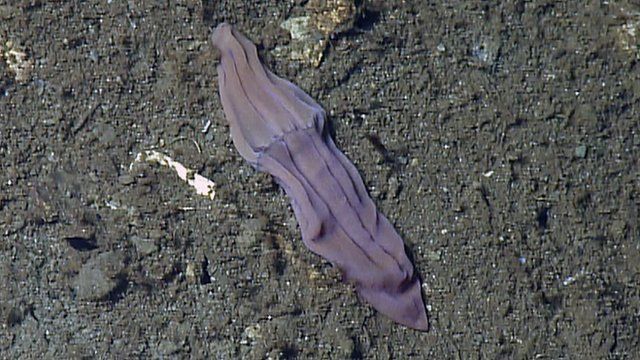
Although the Xenoturbella has been found and known of since 1949, only the recent, closer studies on it decided that this species of deep sea worm is an early life form. And by early, scientists refer to what the very first non-microbial life form may have been like. By studying the species – which divides into 4 different categories – researches may be able to discover just how animals evolved over the length of time.
All four species of Xenoturbella had received a rather hilarious nickname from scientists – purple sock – because of the way it looks. With the shape of a crumpled, discarded purple sock, the Xenoturbella can be found on the very bottom of deep seas and oceans, near cold seeps, hydrothermal vents and some were found near a whale carcass.
A team from Scripps Institution of Oceanography, along with researchers from the Western Australian Museum and the Monterey Bay Aquarium Research Institute managed to collect numerous specimens of the flat-worm-like looking creature over 12 years. After close study in laboratories that focused on anatomy and the mitochondrial genomes, scientists decided that the main species splits into 4 different kinds of Xenoturbella: Xenoturbella Monstrosa, Xenoturbella Profunda, Xenoturbella Churro and Xenoturbella Hollandorum.
The study places the Xenoturbella and other worms known as acoelomorphs closest to all other bilaterally symmetrical animals. The species is believed to have evolved from more complex organisms and the very simple construction of them only suggests just how far back they go. The Xenoturbella doesn’t have any limbs, brain or eyes. The only distinguishable feature of the animal is a small gap that is used as a mouth. Regardless, everything that goes in goes back out through the same ‘mouth’.
At one point throughout history, the Xenoturbella was believed to be a mollusk. While most specimens do not exceed the diameter of a small coin, the largest one ever found was 20 centimeters long and belonged to the Xenoturbella Monstrosa family. The creature only seems to glide on the bottom of the ocean and uses some form of muscles to hold its position. When it contracts its muscles, it’ll look like what gave it its purple sock nickname.
One remaining mystery of the Xenoturbella is its usual diet; scientists have not been able to understand or find traces of what the species feeds on. The rovers sent to study and collect specimens of the Xenoturbella have never witnessed it eating and whenever researchers opened the worms up, their insides would be already empty. Considering the species does not have teeth or a sucking mechanism, it’s difficult to pinpoint what type of sustenance it relies on.
Image Source: 1
