Argyll Free Press

Growing News Network

Tuesday, January 20, 2026
Log in
  • Business
  • Finance
  • Sports
  • Tech & Science
    • HP Envy 4500 Review
    • LG Optimus 170 Review
    • iPod Touch 6th Generation Review
    • HTC One M8 Accessories Set-up
    • Surrealist Games You Must Play
    • Hisense Sero 8 Review
    • Dell Latitude e7440 Review
    • HP Laserjet 1536dnf mfp Review
    • Garmin Fenix 2 Review
    • Skype Vs Viber
    • Best Video Conferencing Software
    • Sony mdr 1r Headphones Review
    • Canon Rebel t3i Review
    • Sennheiser Momentum 2-0 Review
  • Travel
  • Headlines
  • Health
  • United States

Scientists Peer into the Distant Past of the Universe

March 4, 2016 By Cristopher Hall Leave a Comment

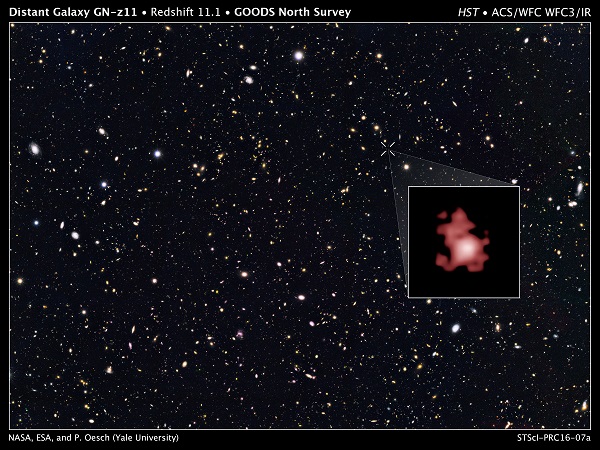
galaxies that are more than 13 billion light years away

Mankind may continue to be grounded to planet Earth for decades, and stuck in this solar system for centuries, but that doesn’t stop scientists from looking at galaxies that are 13.4 billion light years away. This is officially the furthest mankind has seen up to this point, even if the galaxy that they found there shows up as nothing more than a red blotch on a screen.

The whole concept of looking at different galaxies is a little mind-bending to begin with. Whenever scientists peer through telescopes such as Hubble, that is capable of rendering images of extremely distant objects, they are not just looking incredibly far. They are also looking into the past. Every object that is visible through a telescope either produces or reflects light, making us capable of seeing it in the first place. For the light to be seen by human eyes, it has to travel for millions, even billions of years in order to reach the Earth.

That’s why the galaxy that astronomers have found on Thursday is a great reason for excitement. When the researchers realized that the light emitted by galaxy GN-Z11 had travelled for approximately 13.4 billion years to be able to be seen by us, they also had the epiphany that they were actually looking at a very distant age of the universe.

More specifically, they were looking at our universe as it was in its infancy. 400 million years old or 400 million years after the Big Bang to be exact. Or in other words, 3 percent of its current age.

So on the cosmic scale, practically newborn.

But the first question that arises in our heads, of course, is ‘how’ scientists managed to figure out just how far into the past they had peered? The answer lies in a very basic concept that astronomers have used to detect large space object movement such as stars and galaxies orbits for decades. It is called redshift and is regards the light that is emitted from said objects. When they move closer to the observation point, objects tend to glow blue; when they move away, objects tend to glow red.

Naturally, with the expansion of the universe, the GN-Z11 galaxy has a very distinctive red glow. And because it displays an extremely high rate of star formation, it is bright enough to spot; even from 13.4 billion years in the future. Scientists have detected that it grows nearly 20 times faster than our own Milky Way.

This galaxy sighting has resulted in a world record. Scientists believe that the oldest galaxies formed somewhere nearly 200 million years after the Big Bang. What is next? Will there be a day when we witness the very creation of our universe as we know it?

Image Source: 1
Filed Under: Tech & Science Tagged With: Big Bang, Furthest galaxies, Hubble Space Telescope, Observing space

Hubble Captures Blue Bubble Star 30,000 Light Years Away

February 29, 2016 By Karen Jackson Leave a Comment

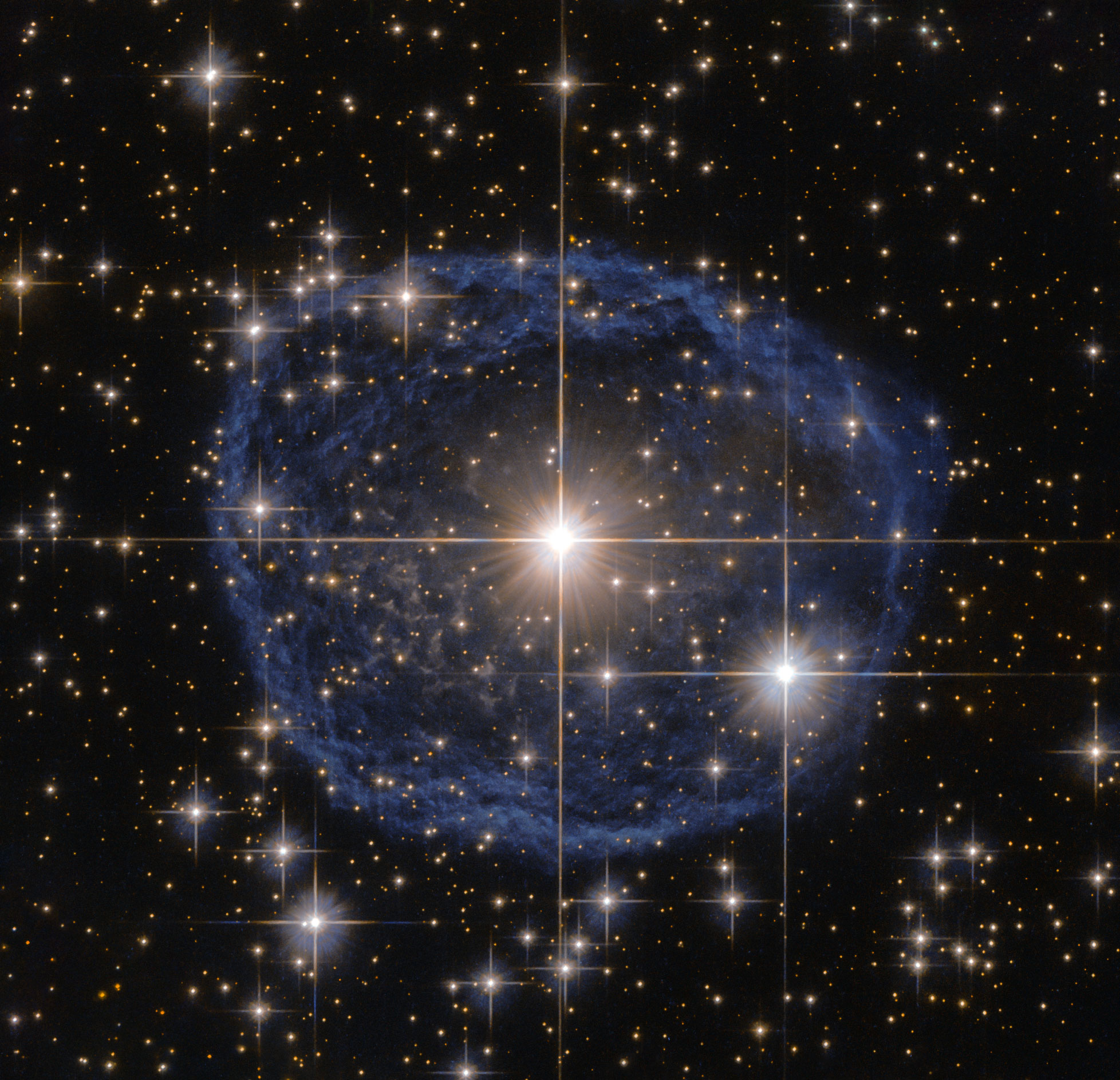
Hubble Captures Blue Bubble Star 30,000 Light Years Away

NASA’s news feed recently posted an image of the endeavors of the space telescope as Hubble captures ‘blue bubble’ star 30,000 light years away. Scientists call it the most detailed photo ever of the WR 31a star. The reason it was dubbed the blue bubble was because it is encased in a gigantic blue cloud that is theorized is made up of hydrogen, dust, helium and other gases.

The star in question is found in the Carina constellation and is part of the Wolf-Rayet (hence the WR abbreviation) set of stars, a group that is known to display unusual spectra. They are also known as plasma spheres that are distinguishable thanks to their emission lines of helium, carbon and nitrogen that reach temperatures of 30,000 to 200,000 degrees Kelvin. Some of them are massive enough to be visible to the naked eye.

The stars belonging to this category tend to have short life spans, explosive births and equally spectacular deaths. Researchers believe that the WR 31a star was born around 20,000 years ago and yet still continues to expand at an approximate speed of 136,700 miles per hour – hence the still very visible cloud.

However, it is believed that the cloud will not persist much longer as the lifespan of stars such as these doesn’t exceed around 100,000 years. It is believed that once the life of the star is over, it will turn into a supernova that will, in time give birth to new generations of stars. On a cosmic perspective, this is incredibly short; just comparing it to our own sun, that is already believed to be 4.5 billion years old and expected to live for another 5, most of the WR type stars barely last long enough for a cosmic breath. And because those stars are nearly 20, 30 times bigger than our own sun, it makes the phenomenon even more impressive.

The stunning-looking blue cloud surrounding the WR 31a star is a result – at least according to theorizing done by scientists that have been studying these stars for a lifetime – of fast-moving stellar winds. When they interact with the outer layers of hydrogen that the WR stars eject, the gloriously large nebulas are formed as a result. Very few nebulas in the part of the universe that our telescopes can see are results of Wolf-Rayet stars.

The image that was posted by NASA on their official website is an enhanced and slightly edited version of what the Hubble Space Telescope was able to capture earlier this month.

Image Source: 1

Filed Under: Uncategorized Tagged With: Hubble Space Telescope, nasa, Nebulas, Wolf-Rayet Stars

Subscribe to Blog via Email

Enter your email address to subscribe to this blog and receive notifications of new posts by email.

Join 10 other subscribers

Recent Articles

police handcuffs man

German Man Probed In Poisoning That Killed 21 Employees Since 2000

June 29, 2018 By Kenneth Scott Leave a Comment

Chicken wings bar

Intoxicated South Carolina Man Punches Waitress Who Refused to Serve Him Alcohol

June 29, 2018 By Karen Jackson Leave a Comment

gaming

New Zealand gamer Who Flew Halfway Across The World for Virginia Teen Gets Shots By Her Mother

June 28, 2018 By Cristopher Hall Leave a Comment

party

Former Virginia Tech Freshman Sentenced to 50 Years in Prison for Stabbing a Girl to Death

June 28, 2018 By Roxanne Briean Leave a Comment

bonfire

British Couple Sentenced to Life in Prison for Torturing and Murdering French Nanny

June 27, 2018 By Deborah Campbell Leave a Comment

pay phone

Texas Father of Girl Disappeared in the 80s Ignored by Authorities

June 26, 2018 By Cristopher Hall Leave a Comment

bottled water

San Francisco Woman Threatened to Call Police on Girl Who Sold Ice Water for Disneyland Trip

June 25, 2018 By Roxanne Briean Leave a Comment

Maplewood Park

Missouri Man Robbed by Date and Accomplice in Park

June 22, 2018 By Nancy Young Leave a Comment

coding

New York Man Sentenced in Cyberstalking Former Girlfriend, Mailing Drugs to Her Dorm

June 22, 2018 By Deborah Campbell Leave a Comment

headphones

Bose Poised to Launch Sleepbuds, In-Ear Headphones That Help You Sleep

June 21, 2018 By Nancy Young Leave a Comment

Police light

Intoxicated Female Driver in Custody for Pulling Arresting Officer by the Hair

June 21, 2018 By Kenneth Scott Leave a Comment

kitchen

Restaurant Manager Arrested and Charged in Shooting Death of Co-Worker over Negative Yelp Reviews

June 20, 2018 By Karen Jackson Leave a Comment

plastic container

Pennsylvania Couple Charged in Violent Death of Infant Discovered Buried in Cat Litter

June 19, 2018 By Cristopher Hall Leave a Comment

tailpipe

Minnesota Teen Gets Head Stuck In Oversized Tailpipe Winstock Music Festival

June 18, 2018 By Karen Jackson Leave a Comment

Pages

  • About Us
  • Contact us
  • Privacy Policy
  • Privacy Policy GDPR
  • Staff
  • Terms and Conditions

Recent Posts

  • German Man Probed In Poisoning That Killed 21 Employees Since 2000 June 29, 2018
  • Intoxicated South Carolina Man Punches Waitress Who Refused to Serve Him Alcohol June 29, 2018
  • New Zealand gamer Who Flew Halfway Across The World for Virginia Teen Gets Shots By Her Mother June 28, 2018
  • Former Virginia Tech Freshman Sentenced to 50 Years in Prison for Stabbing a Girl to Death June 28, 2018
  • British Couple Sentenced to Life in Prison for Torturing and Murdering French Nanny June 27, 2018
  • Texas Father of Girl Disappeared in the 80s Ignored by Authorities June 26, 2018
  • San Francisco Woman Threatened to Call Police on Girl Who Sold Ice Water for Disneyland Trip June 25, 2018

Categories

  • Business
  • Entertainment
  • Finance
  • Headlines
  • Health
  • Life
  • Nature
  • Science
  • Sports
  • Tech & Science
  • Travel
  • Uncategorized
  • United States
  • World

Copyright © 2026 ArgyllFreePress.com
About · Privacy Policy · Terms of Use · Contact
