Barely about 70 years have passed since the first acknowledged computer in the modern sense came into being, namely the ENIAC in 1946, though there is a debate whether the British Colossus of 1943 deserves that title, or even the Atanasoff–Berry computer (ABC) first shown publicly in 1937.
Regardless of which of these ancestors you choose as “origin” though, you have to stand in awe of the massive leaps in… everything that Computer Science and all the other connected technological domains have made since then. I mean processing power, storage, design, human-computer interface, you name it. The computers we have today are in my subjective opinion, as evolved to those first computers as a sophisticated modern human to a primate.
And we have now reached a new level. Where more is desired than just a “plain” modern computer. Researches across the world have already developed supercomputers and are working on improving these technological wonder’s performance even further (not to mention changing the game considerably if we take into account research and progress being done with regard to quantum computers).
So, in this context, there should be no surprise that there is a race currently going on. For who can build the fastest supercomputer to dethrone the current title holder, the Chinese Tianhe-2 with a top performance of a boggling 54.9 petaflops.
To put things into perspective: the petaflop is the measuring unit for processing speed. One petaflop equals a quadrillion floating point operations per second (FLOPS). Now multiply that by 54.9 and you get the idea of how fast the currently fastest supercomputer can process floating point operations. I know, it’s hard to conceive doing just 2 or 3 of them simultaneously as a human…
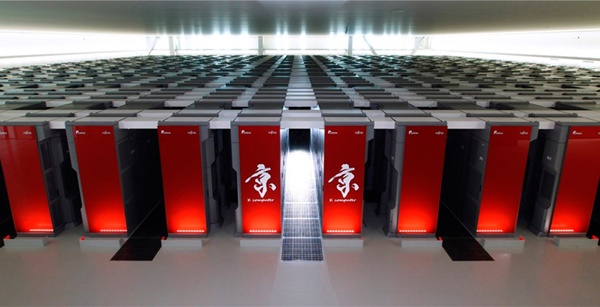
But that’s a cinch compared to the goals that the three top participants in this race have set for themselves. China wants to beat its own record by making a supercomputer that can operate at 100 petaflops. The USA have announced a 180 petaflops capable system to be released by 2019 and Japan has just announced plans to release a new supercomputer by 2020 to replace its currently third-place holder, the K, which operates at 10.5 petaflops thanks to the 705,204 processing cores it is equipped with.
More details on the new Japanese supercomputer are being given to the public today at at the Supercomputer 15 conference in Austin, Texas.
What is clear so far is that Japan has declared its intentions to make the new K able to offer 100 more times application performance than its predecessor and that the same research institution that developed the current K will also develop the new one, in collaboration with Fujitsu and also that the system will be based on a Linux Operating System.
Image source: 1.
