It seems there is no better muse for innovative tools than nature itself – and it’s almost hilarious just how nature inspires innovative technology in our days. There is a shocking amount of ingenuity scientists take from the way things work in the nature in order to bring some new contraption into the class of innovations – whether they manifest in terms of utility or leisure.
Just recently, some researchers were discussing what a ‘roach’ robot would be like if it was built in order to assist with natural disaster such as earthquakes or collapsed buildings. By studying the way roaches move and manage to squeeze through spaces much smaller than their normal size, a prototype was begun shortly after.
Now, another group of scientists is moving their gaze towards another aspect of nature that can help mankind with using air as a source of water. Their inspiration? It’s more than just one thing this time around: a darkling beetle, a species of carnivorous plant and even a cactus. However, the final result is far from looking like any of the above.
Instead, the end result is a material covered in microscopic bumps. But it’s an overstatement to say that it can just draw water out of thin air like that. Instead, these panels that were built by MIT graduate student Kyoo-Chul Park excel at drawing water out of foggy atmosphere. This is achieved thanks to the nature of the surfaces that are made to allow water to condense on them.
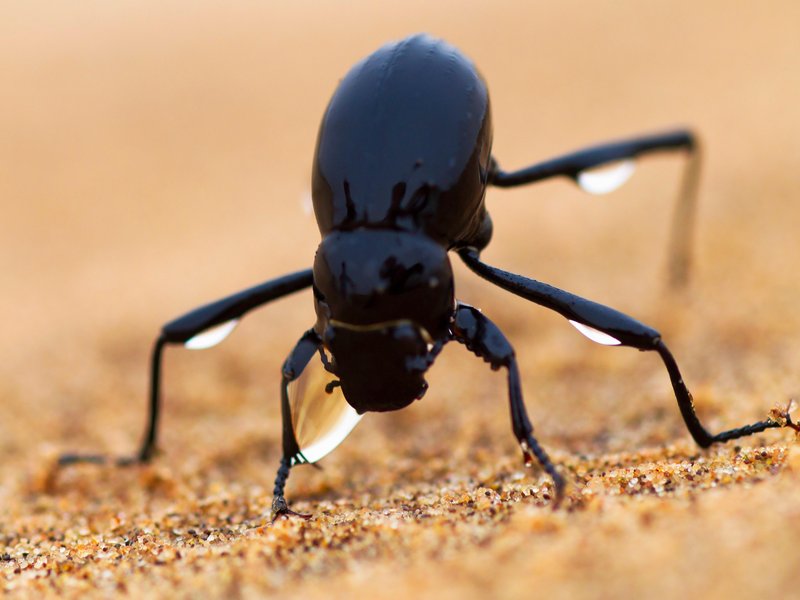
So in essence, a phenomenon scientists noticed in the beetles that live in southern Africa was how they managed to survive on less than a centimeter of rain in an entire year. The way the beetles do that is by harvesting fog that is incoming from the Atlantic Ocean by pointing their bodies upwards and letting them serve as a surface for water to condense on.
But that alone was not enough. Upon closer inspection they noticed that the bodies of the insects display a series of small bumps made from something that would attract water, while the spaces between them were water-repelling. Therefore, water would be collected onto the bumps, while the ‘valleys’ created by them would serve as channels that would help the water travel.
Using that concept, scientists were able to design a surface that would do the exact same thing and allow the same process to take place. By placing such panels in places where water supplies are scarce or the weather is hot enough to not allow clouds to coalesce and rain, this could prove as a solution.
Image Source: 1
