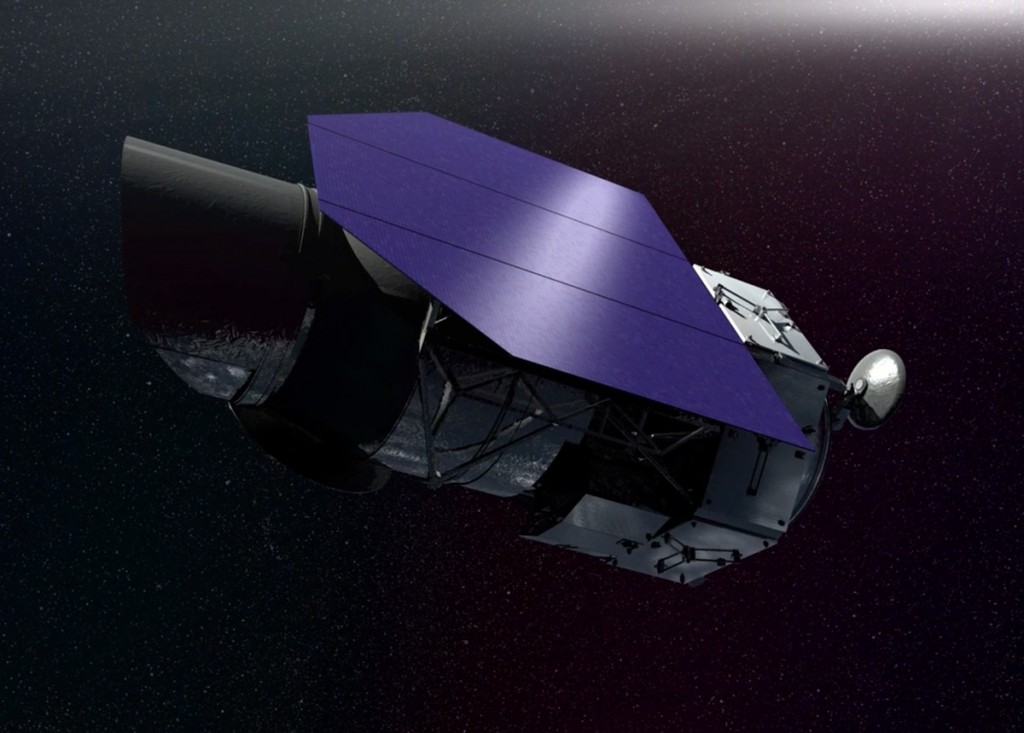
It would seem that the grounded FAST telescope is not the only one aspiring to places further away as NASA is building an improved Hubble telescope, featuring a field of view 100 times wider than before. The new telescope being built by the National Aeronautics and Space Administration has been dubbed the Wide-Field Infrared Survey Telescope (WFIRST) and is expected to be put to work in mid-2020s.
The space telescope is being built with the aspiration of searching for alien worlds beyond our solar system as well as a further study of dark energy and dark matter and their mysterious effects. The two objectives may seem wildly different from one another, but the former comes as a complement to already existent Kepler mission as well as the upcoming Transiting Exoplanet Survey Satellite project. The latter is simply a continuation of what scientists have been interested and baffled by for years.
Thanks to its construction, the WFIRST telescope will feature a new, wide-field survey tool that is accompanied by a coronagraph instrument that helps filter out effects such as glare from stars and reflected light. These usually make it hard for researchers to spot things such as dark matter and dark energy. But removing that factor also helps produce measurements of chemical composition of atmospheres of other worlds.
WFIRST will be able to measure with much better precision not only distances, but also tri-dimensional positions and shapes of distant galaxies, providing scientists with much better insight regarding the evolution and workings of the universe.
Once completed and sent out in outer space, the WFIRST telescope will take its position in the Earth-sun L2, a location that is considered a balance point situated at approximately 1 million miles from our planet, in a directly opposite orientation in relation to the sun.
The WFIRST telescope will be taking onto multiple quests of discovery, and thanks to the improved capabilities that it comes will, will certainly open up new paths of research for scientists, even in topics such as the growth of cosmic structures, cosmic expansion that is believed to happen with time, physics of atmospheres, and other top priority tagged issues of the astronomical community.
Image Source: 1
