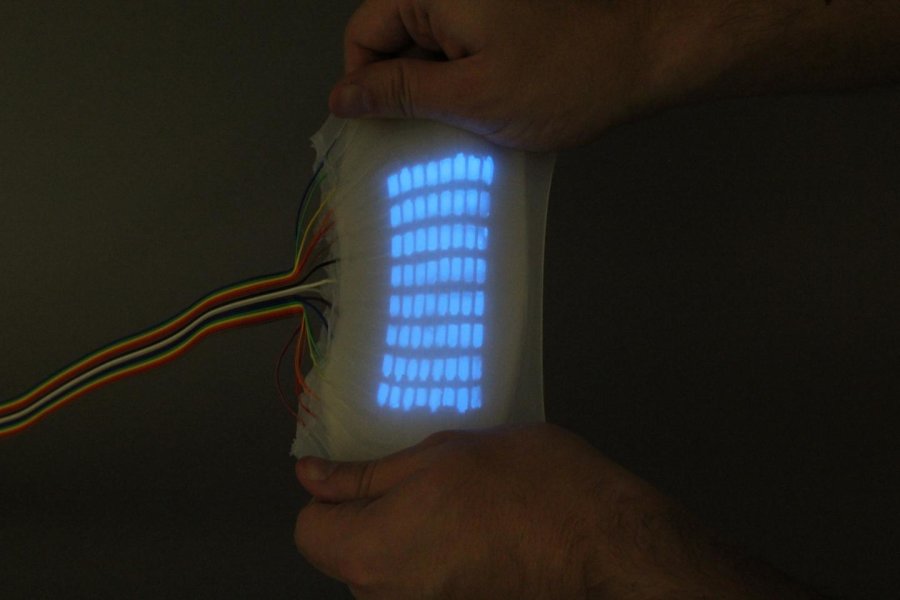
A very recent invention which can only be described as a type of electroluminescent skin could give a whole lot more versatility to our future robots. And this new technology that was developed by a team of graduate students from Cornell University – and led by assistant professor of mechanical and aerospace engineering Rob Shepherd – doesn’t even have to limit itself to robots.
This electroluminescent skin has the amazing ability to stretch up to more than six times its original size without losing any of its light-emitting properties. The previous prototype of this robotic skin, academically known as a hyper-elastic light-emitting capacitor (HLEC) could only endure half of what the current version can.
It is made of multiple payers of transparent hydrogel electrodes that cover an insulating elastomer sheet on both sides. The capacitors inside this material can continue to shine no matter the amount of pressure applied to it, the way it is stretched, rolled or deformed from its original shape and size. The original idea that inspired Robert Shepherd to start working on this material was studying the way octopuses behave in their natural habitat. They are capable of changing their color and their texture to match the surroundings they wish to blend in.
So the future utilities of such a material are very diverse and can go huge lengths. The first application that comes to mind is the use of this type of skin for our future robots of course. Because this kind of material can shape around any form and change its color, it could have a huge impact on our lives as robots slowly become part of it too. Scientists believe that a robot that can react to the mood of a room could play an imperative role in human-robot interactions.
Secondly, this type of technology could easily be used in smart devices such as smartphones. Imagine owning a phone the size of a Samsung Galaxy S6 that can stretch to the scale of a full-fledged tablet in a matter of seconds, without losing display quality of functionality.
Lastly, while not as thoroughly discussed, scientists have considered the possibility of using a material such as the electroluminescent skin for military purposes. The research that the Cornell University group underwent was funded by the Army and Air Force, so in reality, chances are very high that it will also end up being used as an advanced type of camouflage for missions.
Image Source: 1
