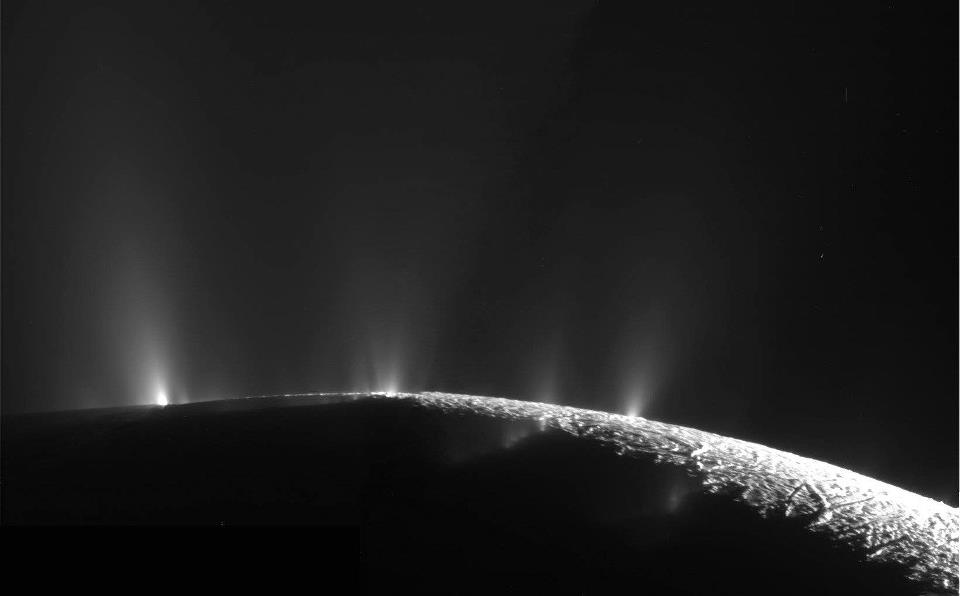
Ever since its discovery more than two centuries ago and its close-up study that the Cassini space craft performed on it in 2005, Enceladus is still a mystery to scientists. The reason behind that is its high concentration of water and water ice as well as what is believed to be an entire south polar subsurface ocean that goes as deep as 10 kilometers.
But that is not even the most fascinating feature about the sixth largest moon of Saturn. An act that Enceladus puts on and was first noticed thanks to the Cassini space craft more than 10 years ago is its intricate series of geysers that happen over long periods of time. While the phenomenon is a hauntingly amazing process to witness, scientists have yet to be able to explain why it takes place and how come they don’t freeze in the harsh temperature of negative 198 degrees Celsius (or -324.4 degrees Fahrenheit).
For starters, scientists believe that the reason eruptions would last longer than they do on Earth would be them taking place through a pipe-like system that puts a lot of space between them.
However, the discovery of these geysers bring an extra ounce of proof that Enceladus may, indeed, be hiding a large subsurface ocean at its south pole, below the fissures that researchers occasionally also call ‘tiger stripes’. If such an ocean truly exists, it could explain the geysers as being the result of what on Earth we would consider tidal forces. However, because it is completely hidden with a thick layer of ice at the surface, the forces would act upwards instead, creating the geysers and their continuous eruptions.
The timing of the eruptions has – for a while – left scientists in a pickle as they would always take place approximately five hours later than they would’ve if they were caused by tidal forces as the scientists had predicted. But that is no reason the theory should be immediately rendered invalid. Researchers have theorized that there are various scenarios in which such delay could exist based on a model that functions on a separate series of variables.
According to the results of this model, scientists can finally find out whether they were right to predict a subsurface ocean as well as explain the nature of the geyser eruptions that turn Enceladus into one of the most intriguing space objects we have witnessed in our solar system.
Image Source: 1
