There has been a tremendous amount of star gazing, galaxy hunting and dreams of expeditions in outer space lately, not to mention that scientists are looking for Milky Way newborn solar systems. But while prospects may seem like distant goals for mankind to anyone not in touch with the scientists’ sheer ability to perform these studies, they are far from it. Just recently, plans of telescopes being built in China or sent out to orbit in outer space promise us capabilities that we hadn’t even thought of before, extending the reach of our eyes at least to the vast grandeur of the universe we live in.
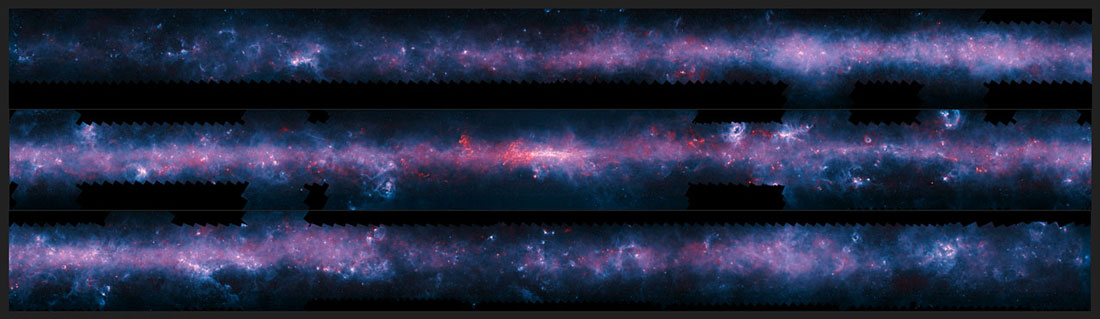
While just recently scientists reported their discoveries regarding a different galaxy that lies about 55 million light years away, another group took a glance at a place that’s a little closer to us – the Milky Way. After a long session of photographs and prolonged studies of our galaxy that started years ago, astronomers have just managed to complete a detailed map of the dense and cold gas in our galaxy. The reason behind it? The gasses in question are the places where new stars are made. In other words, scientists marked the places where new solar systems will once day form.
Everything was done with the help of the Apex telescope that rests at an altitude of 5,100 meters in the Atacama Desert. Over the length of many years, it slowly looked around and mapped as far as it could see inside our own Milky Way. In between its extensive search for answers and insight into the activity of our galaxy, it found an extremely long strip of star-forming gasses in the southern sky.
The way this was achieved was by making use of a special detector, known as a super-chilled thermometer that reads radiation between radio and infrared waves. But it’s most important feature is the Large Bolometer Camera (Laboca) that it has; consisting of 295 sensors that are maintained at a temperature of 0.3 degrees above absolute zero, it is the ‘weapon of choice’ for the Atacama Pathfinder Experiment.
The map that was created with the help of Laboca was dubbed Atlasgal and provides a great amount of information regarding the high-mass stars and clusters that will appear in the Milky Way Galaxy over the next hundreds of thousands or even millions of years. The map rendered covers an area of sky that is 140 degrees long and merely 3 degrees wide but provides a good starting point for future descoveries.
Image Source: 1
