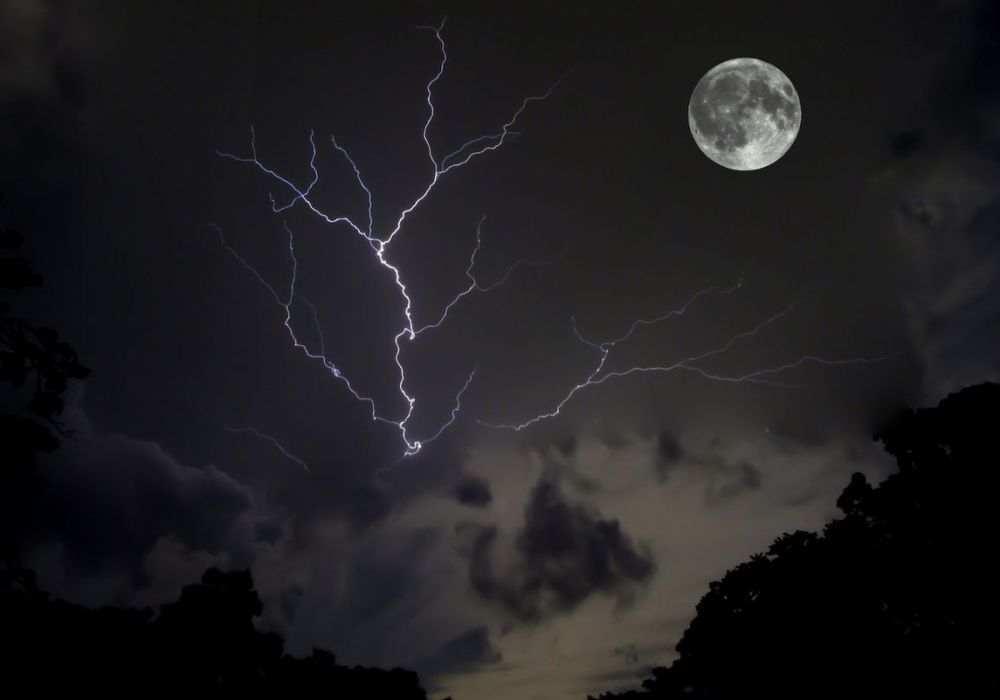
Following a study that stretched over a length of 15 years, two scientists from the University of Washington have concluded that rainfall may be influenced by the position of the moon. Tsubasa Kohyama and professor John Wallace have studied data gathered by NASA and the Japan Aerospace Exploration Agency’s Tropical Rainfall Measuring Mission between 1997 and 2012 in order to detect if the moon doesn’t, by any chance, have something to do with the rainfall patterns on Earth.
It would appear that the moon has more to do with rainfall, even if it’s not as drastic as the gravitational pull that it has on oceans at a planetary level. The scientists’ conclusion was that while the moon is either directly overhead or underfoot, it creates an increased air pressure level, which in turn allows more moisture to be preserved.
For example, when the moon is directly overhead, its gravitational pull will morph the shape of the Earth’s atmosphere, causing it to expand while being subjected to higher atmospheric pressure. Because the effect of the higher pressure is an increase in temperature, it becomes less likely moisture to be released. In other words, it is less likely to rain.
This is the most recent discovery that the scientists have made; this is after all, a study that has been ongoing for years. Previous discoveries have slowly built up to the conclusion that the study suggests. A previous discovery that was made in 2014 helped reach the point that the study that was published last Saturday in the Geophysical Research Letters is making.
The two scientists had concluded somewhere in 2014 that there was a definite connection between the air pressure on Earth and the moon’s phases because the former seemed to increase during particular moments of the moon cycle. Based on that knowledge, the two scientists were able to detect the slight difference in numbers and finally reach the conclusions that is supported in the paper.
However, even though the authors have clear proof of their theory, it is not a fact that has a major effect on the way we should regard precipitation. The conclusion that the two scientists have reached is only something that remains relevant only in the academic field as the overall variation due to the moon’s phases only amounts up to 1% so it’s hardly a relevant factor in our day to day lives. This may, however, lead to further discoveries of our moon’s effect on the planet.
Image Source: 1
