Argyll Free Press

Growing News Network

Thursday, April 23, 2026
Log in
  • Business
  • Finance
  • Sports
  • Tech & Science
    • HP Envy 4500 Review
    • LG Optimus 170 Review
    • iPod Touch 6th Generation Review
    • HTC One M8 Accessories Set-up
    • Surrealist Games You Must Play
    • Hisense Sero 8 Review
    • Dell Latitude e7440 Review
    • HP Laserjet 1536dnf mfp Review
    • Garmin Fenix 2 Review
    • Skype Vs Viber
    • Best Video Conferencing Software
    • Sony mdr 1r Headphones Review
    • Canon Rebel t3i Review
    • Sennheiser Momentum 2-0 Review
  • Travel
  • Headlines
  • Health
  • United States

New Horizons’ Flyby of Pluto Concludes into Five Papers

March 18, 2016 By Karen Jackson Leave a Comment

New Horizons fulfilled the mission it set out for

Ever since New Horizons fulfilled the mission it set out for more than ten years ago – to do a flyby of the dwarf planet Pluto – scientists have been thoroughly caught with studying every single piece of data and image that the probe beamed back to Earth. It is not very clear why humanity feels a strong attraction to the small, frozen and distant planet of our solar system. However, ever since its discovery in 1930, scientists have put in superhuman efforts to understand the peculiar nature of one of the last known objects of the solar system we live in.

This week, New Horizons scientists have finally published no less than five papers regarding Pluto in the journal Science, detailing all findings that they have achieved following the probe’s flyby of Pluto’s system during last summer. What was previously believed to be a dark, cold piece of rock slowly drifting onto the very edges of the solar system is now depicted of having a complex world with active and varied geology, what appears to be an atmosphere that can generate clouds of unknown chemistry.

And as small as this dwarf planet is, it still manages to maintain an entire system of even smaller moons and shows what appears to be a very animated world, despite its location at an average 39.5 astronomical units (AU; 1 astronomical unit equals roughly 143 million kilometers or 93 million miles) from the sun.

The first set of papers that are being published following the staggering exploration of New Horizons, the space craft that literally has gone where no man had gone before, even if remotely, treat the various aspects of the numerous discoveries made by scientists from nearly 50 gigabits of data that was collected by the craft. Out of everything that New Horizons has seen and learned, researchers have compiled a list of several central points of their findings, as they are treated and explained in the papers.

The geologic analysis of Pluto’s surface revealed a planet that has been active in the past 4 billion years, while some of its geographical areas are smooth and lacking in craters, which suggests young and newly formed (in astronomical terms, 10 million years old does qualify as new) planes. Studying Pluto’s atmosphere revealed possible reasons behind the formation of what is now known as the planet’s haze players, as well as temperature levels and the composition that seems to different depending on altitude.

The summary of all the findings that the New Horizons made during its five months spent nearby Pluto’s system can be found in PDF form on the Science Magazine official website.

Image Source: 1

Filed Under: Tech & Science Tagged With: new horizons, Pluto flyby, Pluto Study, pluto surface, Pluto system

Pluto May Have Its Planet Status Reinstated

March 8, 2016 By Deborah Campbell Leave a Comment

Pluto May Have Its Planet Status Reinstated

The very long history of one of the smallest and furthest away object in our solar system, Pluto may have its planet status reinstated after it was revoked back in 2006. The reason behind that was a nearly unanimous vote that due to Pluto’s size and position in the solar system, along with the discovery of several other small planets displaying similar features in what was later called the Kuiper Belt. Instead, it became a dwarf planet in accordance to the 424 astronomers who attended the meeting of the International Astronomical Union in Prague in 2006.

Ever since New Horizons probe’s flyby of Pluto that was done in the summer of 2015, new data is being extracted from the wide variety of images that were captured from various altitudes and positions. Along with its floating glaciers in the Sputnik Planum and wildly diverse geological formation, a more recent observation that scientists made when studying the images of Pluto may just be the first step towards reinstating it as a planet.

A particular image displaying the surface of the dark Pluto from an angle shows the very thin layer that is its atmosphere. However, the detail that brought a considerable amount of debate regarding the image in question is the presence of several wispy areas on the very edge of the atmosphere; almost as if there were clouds present on Pluto. Scientists have called them ‘extremely bright low altitude limb haze’ instead, as it is not yet certain what the exact nature of those masses is.

Researchers on the New Horizons project believe that they are composed of nitrogen, methane as well as other gases otherwise existent in Pluto’s atmosphere.

This does not, however, bring direct evidence that Pluto should once again be considered a full-fledged planet as it does not pertain to any of the requirements that scientists have decided are necessary in order for a space object to be considered one.

Pluto is a very unusual object in our solar system, displaying an elliptical orbit that takes it 248 Earth years to complete. It is a lot more elongated than the orbits of the other eight planets in our solar system, as well as displaying an inclination of 17 degrees in relation to the other orbits present. While Pluto fulfills the basic requirements, it acts as if is being pulled away by a different object, straying from the normal orbit around the Sun.

If the discovery of ‘clouds’ turns out to be true, scientists may consider rephrasing the requirements that an object must present in order to be considered a planet, and as a result, Pluto being reinstated as the 9th planet of our solar system.

Image Source: 1

Filed Under: Tech & Science Tagged With: new horizons, Pluto, Pluto atmosphere, Pluto's status as a planet

New Horizons Data Still Keeps Shedding Light on Pluto

February 26, 2016 By Nancy Young Leave a Comment

New Horizons Data Still Keeps Shedding Light on Pluto

Even if it has been more than half a year since the probe’s fly-by of Pluto, the New Horizons data still keeps shedding light on Pluto. Images of the planet and data reads have been incoming from the distant probe ever since it has gone out of hibernation and gone back in action. This data has gone through multiple testing phases and research with the scientists from NASA since; after that, the data has slowly been made available to the public in order to share with the rest of humanity just how far our species has gone.

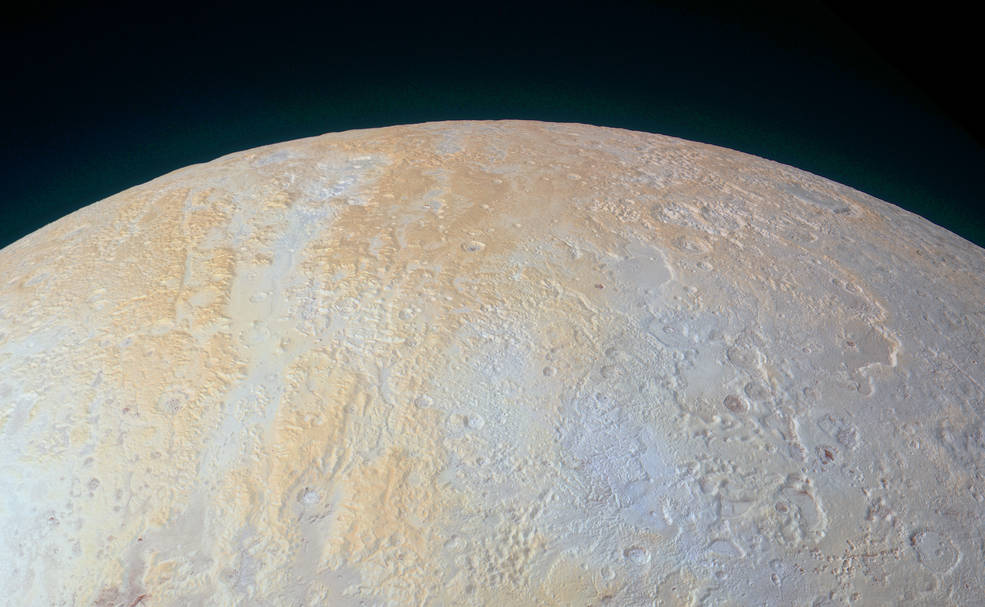
The most recent discovery that has been thrown our way by the NASA newsfeed is a beautiful picture of Pluto’s North Pole. The image was taken by New Horizons using the Ralph/Multispectral Visible Imaging Camera (MVIC), at an altitude of 21,100 miles from the surface of Pluto and about 45 minutes after the probe’s closest approach to the dwarf planet on July 14th 2015.

The image depicts heavily battered terrain and incredibly long canyons scarring the entirety of that area. The canyons run through Pluto’s Lowell Region – also known as the Percival Lowell area – some of them as wide as 45 miles across. A closer study made on the nature of the canyons that seem to run close to the north pole of the planet has revealed that the ravines walls appear to look old; at least older than other, sharper canyon regions that were found on the planet.

Scientists have theorized two possible reasons for that: one would be that the canyons in this region are made of weaker materials that degrade faster. The other explanation would suggest that Pluto had tectonic activity in the past. The deepest of canyons measure about 2.5 miles depth in this particular region. Researchers also theorized that their creation may very well have been a result of subsurface ice melting below the ground, eventually causing a cave-in.

Scientists have also made a point of observing the yellow terrains that are particularly visible closer to the North Pole than they are in the other regions of the planet. While it’s not with a hundred percent certainty, scientists suspect that the hue is a result of methane deposits that ended up being processed more by the solar radiation than bluer terrain in other zones on the planet.

Image Source: 1

Filed Under: Tech & Science Tagged With: new horizons, Pluto, Pluto North Pole, pluto surface

New Horizons Helps Map the Geological Formation of Pluto

February 16, 2016 By Michael Turner Leave a Comment

New Horizons Helps Map the Geological Formation of Pluto

Seeing a real life photo of the dwarf planet is not quite enough, you’d think, but New Horizons helps map the geological formation of Pluto too. It was only recently that NASA released a photo the space craft took of the area known as Sputnik Planum on the surface of the tiny member of the Kuiper Belt. But while that was what the public was shown, it wasn’t the only photo taken by New Horizons.

After the staggering discovery that the original picture taken by New Horizons with its Long Range Reconnaissance Imager (LORRI) in July 2015 was actually displaying floating glaciers, because of the density difference between the water ice as well as the frozen nitrogen that the planet’s plain mostly consists of, scientists took a closer look to what are the components that create Pluto’s geography.

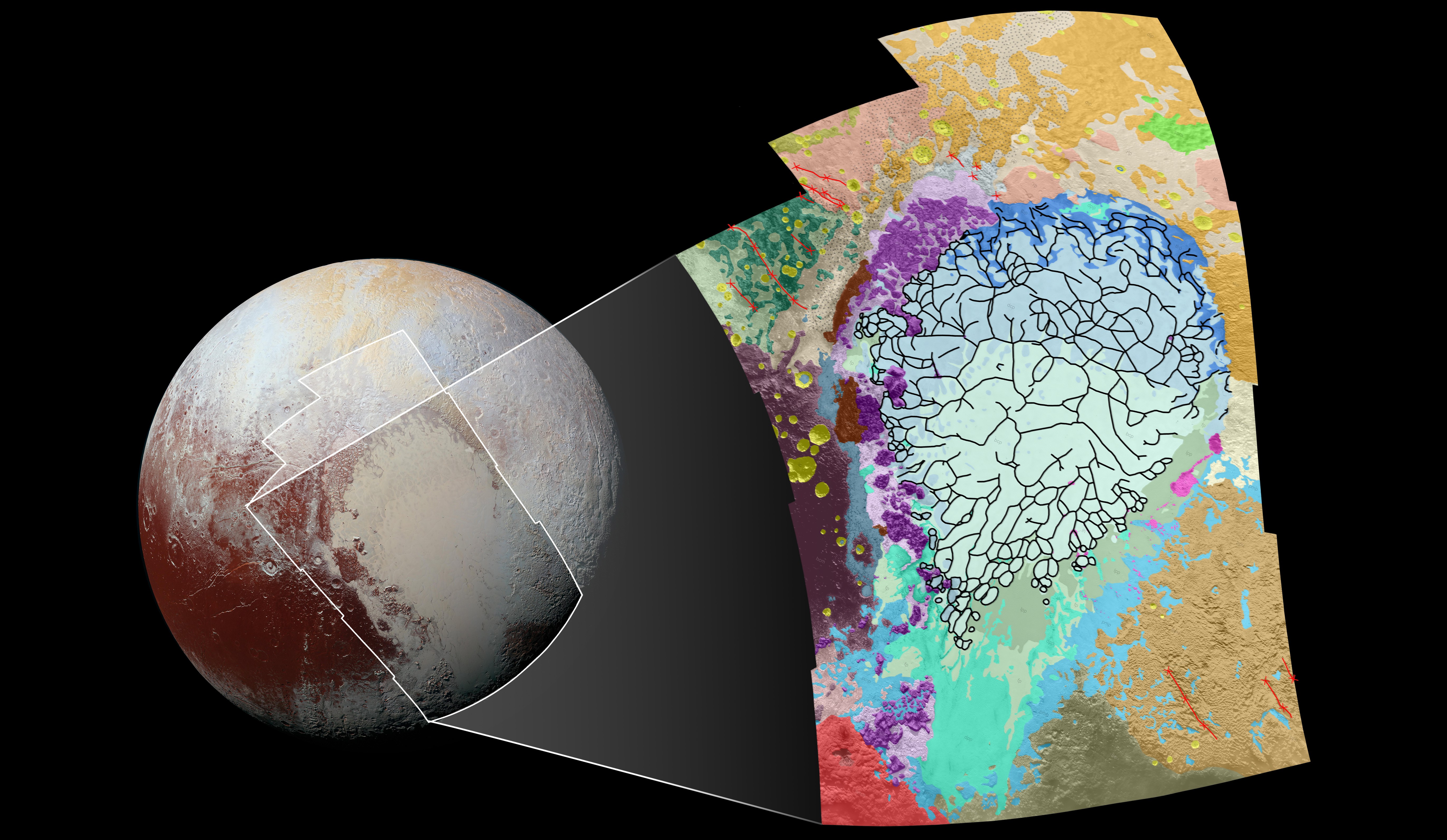
Researchers have actually managed to map as much as 1,290 miles across and around the Sputnik Planum in different visual wavelengths, depicting the different types of terrain on the surface of the frozen planet. The colored history of the map that was rendered in a scale of 1,050 feet per pixel should be able to reveal more of the geographical formation of the planet.

Therefore, purple areas indicate the blocky mountain edge of the Sputnik Planum, described by NASA as chaotic and angular and pink is the representation of floating ice. Yellow areas represent well-preserved impact craters while the darker brown areas are various types of uplands. To the west of Sputnik Planum, you can see rugged, heavily cratered material, while the very south western corner of the image shows hummocky mound material and a possible cryovolcanic feature named Wright Mons.

There are a lot of things scientists can gather from images such as this one because they provide a huge amount of insight into the history of the geographical formation of the planet’s surface. Considering that New Horizons has reached its destination and did its purposed flyby of Pluto last summer, now heading to unknown parts of the solar system, this was a secluded chance for humanity to see and try to understand the things that we may not see in person in the next few decades.

The geologic map was obtained by creating a mosaic of the 12 images that the LORRI device took of the planet during its flyby of Pluto from a range of 48,000 miles from the surface. Scientists say that this is a very important resource for the study of the planet as it’s an efficient method of understanding the processes that have undergone on Pluto to result in the planet’s battered and intriguing surface.

Image Source: 1

Filed Under: Tech & Science Tagged With: Kuiper Belt, new horizons, Pluto geography, pluto images

More Astonishing News From New Horizons Spacecraft

February 5, 2016 By Michael Turner Leave a Comment

More Astonishing News from New Horizons Spacecraft

Mere days ago, we were graced with a real life image of Charon as it was taken last summer from the edges of the solar system and now we have even more astonishing news form New Horizons spacecraft. This time it’s about Pluto itself, and the amazing images that were rendered by NASA after the space probe that was launched back in 2006 did a fly by the dwarf planet last year during the summer.

The data that the probe has been feeding and beaming back to Earth along its 10-year trip has provided an immense amount of insight about the workings of our own solar system and truly went where nobody had been before. The newest news feeds from NASA display even more information that New Horizons has gathered from the farthest edges of our solar system; and more explicitly images and recordings of the dwarf planet Pluto.

Scientists have been studying all of the data gathered from Pluto ever since it first started getting fed to them back on Earth. A new analysis suggests that Pluto’s glaciers and made of water ice and that they float similarly to how icebergs do on the surface of the earth.

The reason this is possible is because of a difference in density. Because the water ice that the glaciers are made of has a lower density of the frozen nitrogen that the surface below them has (also common to objects in the Kuiper belt), they tend to ‘float’ or travel slowly. Although the glaciers there remain hard and frozen solid due to the -380 degrees Fahrenheit temperature on Pluto, they seem to break apart and move in a series.

These were conclusions drawn after closely studying the images depicting one particular zone of the planet Pluto – namely the Sputnik Planum. It was detected that the glaciers would slowly move across the flat plane, sometimes as much as 12 miles across it. In earth terms, this would translate in gigantic icebergs that move across the frozen oceans. Except in Pluto’s case, it’s a gigantic frozen surface of nitrogen.

A particular portion of the Sputnik Planum, namely the Challenger Colles, appears to be a large accumulation of these glaciers. Scientists speculate that this is a place where the nitrogen ice below is shallower than in other parts, making the water ice glaciers ‘station’ and gather here. The Challenger Colles zone is 37 by 22 miles, while the entire Sputnik Planum zone is believed to span for about 300 by 210 miles.

The image taken by New Horizons was captured about 12 minutes before the probe’s closest approach to Pluto, from a range of approximately 9,950 miles from the surface on July 14th, 2015.

Image Source: 1

Filed Under: Tech & Science Tagged With: new horizons, new horizons probe, pluto images, pluto surface

Subscribe to Blog via Email

Enter your email address to subscribe to this blog and receive notifications of new posts by email.

Join 11 other subscribers

Recent Articles

police handcuffs man

German Man Probed In Poisoning That Killed 21 Employees Since 2000

June 29, 2018 By Kenneth Scott Leave a Comment

Chicken wings bar

Intoxicated South Carolina Man Punches Waitress Who Refused to Serve Him Alcohol

June 29, 2018 By Karen Jackson Leave a Comment

gaming

New Zealand gamer Who Flew Halfway Across The World for Virginia Teen Gets Shots By Her Mother

June 28, 2018 By Cristopher Hall Leave a Comment

party

Former Virginia Tech Freshman Sentenced to 50 Years in Prison for Stabbing a Girl to Death

June 28, 2018 By Roxanne Briean Leave a Comment

bonfire

British Couple Sentenced to Life in Prison for Torturing and Murdering French Nanny

June 27, 2018 By Deborah Campbell Leave a Comment

pay phone

Texas Father of Girl Disappeared in the 80s Ignored by Authorities

June 26, 2018 By Cristopher Hall Leave a Comment

bottled water

San Francisco Woman Threatened to Call Police on Girl Who Sold Ice Water for Disneyland Trip

June 25, 2018 By Roxanne Briean Leave a Comment

Maplewood Park

Missouri Man Robbed by Date and Accomplice in Park

June 22, 2018 By Nancy Young Leave a Comment

coding

New York Man Sentenced in Cyberstalking Former Girlfriend, Mailing Drugs to Her Dorm

June 22, 2018 By Deborah Campbell Leave a Comment

headphones

Bose Poised to Launch Sleepbuds, In-Ear Headphones That Help You Sleep

June 21, 2018 By Nancy Young Leave a Comment

Police light

Intoxicated Female Driver in Custody for Pulling Arresting Officer by the Hair

June 21, 2018 By Kenneth Scott Leave a Comment

kitchen

Restaurant Manager Arrested and Charged in Shooting Death of Co-Worker over Negative Yelp Reviews

June 20, 2018 By Karen Jackson Leave a Comment

plastic container

Pennsylvania Couple Charged in Violent Death of Infant Discovered Buried in Cat Litter

June 19, 2018 By Cristopher Hall Leave a Comment

tailpipe

Minnesota Teen Gets Head Stuck In Oversized Tailpipe Winstock Music Festival

June 18, 2018 By Karen Jackson Leave a Comment

Pages

  • About Us
  • Contact us
  • Privacy Policy
  • Privacy Policy GDPR
  • Staff
  • Terms and Conditions

Recent Posts

  • German Man Probed In Poisoning That Killed 21 Employees Since 2000 June 29, 2018
  • Intoxicated South Carolina Man Punches Waitress Who Refused to Serve Him Alcohol June 29, 2018
  • New Zealand gamer Who Flew Halfway Across The World for Virginia Teen Gets Shots By Her Mother June 28, 2018
  • Former Virginia Tech Freshman Sentenced to 50 Years in Prison for Stabbing a Girl to Death June 28, 2018
  • British Couple Sentenced to Life in Prison for Torturing and Murdering French Nanny June 27, 2018
  • Texas Father of Girl Disappeared in the 80s Ignored by Authorities June 26, 2018
  • San Francisco Woman Threatened to Call Police on Girl Who Sold Ice Water for Disneyland Trip June 25, 2018

Categories

  • Business
  • Entertainment
  • Finance
  • Headlines
  • Health
  • Life
  • Nature
  • Science
  • Sports
  • Tech & Science
  • Travel
  • Uncategorized
  • United States
  • World

Copyright © 2026 ArgyllFreePress.com
About · Privacy Policy · Terms of Use · Contact