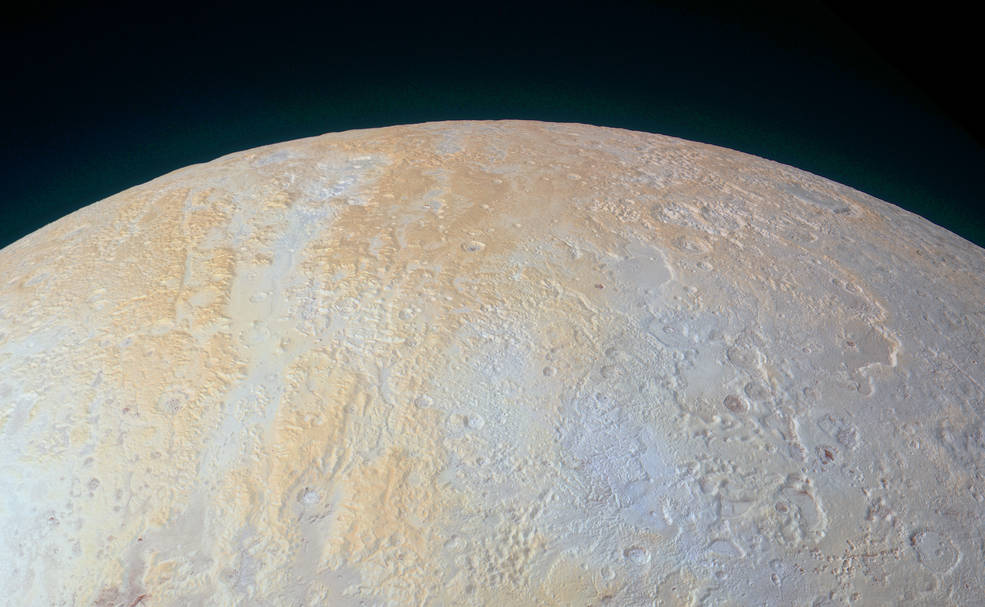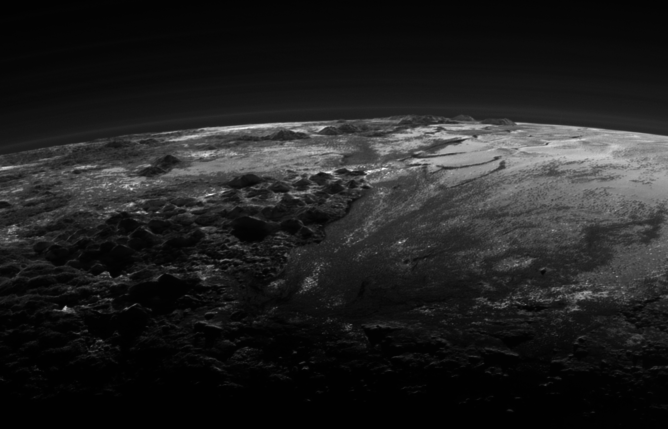
Ever since New Horizons fulfilled the mission it set out for more than ten years ago – to do a flyby of the dwarf planet Pluto – scientists have been thoroughly caught with studying every single piece of data and image that the probe beamed back to Earth. It is not very clear why humanity feels a strong attraction to the small, frozen and distant planet of our solar system. However, ever since its discovery in 1930, scientists have put in superhuman efforts to understand the peculiar nature of one of the last known objects of the solar system we live in.
This week, New Horizons scientists have finally published no less than five papers regarding Pluto in the journal Science, detailing all findings that they have achieved following the probe’s flyby of Pluto’s system during last summer. What was previously believed to be a dark, cold piece of rock slowly drifting onto the very edges of the solar system is now depicted of having a complex world with active and varied geology, what appears to be an atmosphere that can generate clouds of unknown chemistry.
And as small as this dwarf planet is, it still manages to maintain an entire system of even smaller moons and shows what appears to be a very animated world, despite its location at an average 39.5 astronomical units (AU; 1 astronomical unit equals roughly 143 million kilometers or 93 million miles) from the sun.
The first set of papers that are being published following the staggering exploration of New Horizons, the space craft that literally has gone where no man had gone before, even if remotely, treat the various aspects of the numerous discoveries made by scientists from nearly 50 gigabits of data that was collected by the craft. Out of everything that New Horizons has seen and learned, researchers have compiled a list of several central points of their findings, as they are treated and explained in the papers.
The geologic analysis of Pluto’s surface revealed a planet that has been active in the past 4 billion years, while some of its geographical areas are smooth and lacking in craters, which suggests young and newly formed (in astronomical terms, 10 million years old does qualify as new) planes. Studying Pluto’s atmosphere revealed possible reasons behind the formation of what is now known as the planet’s haze players, as well as temperature levels and the composition that seems to different depending on altitude.
The summary of all the findings that the New Horizons made during its five months spent nearby Pluto’s system can be found in PDF form on the Science Magazine official website.
Image Source: 1