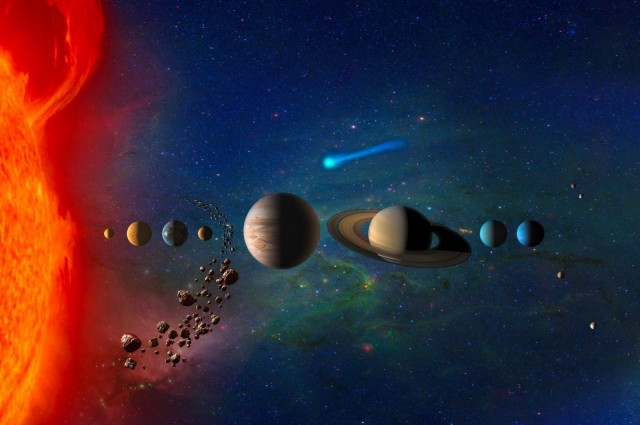
A Duke University theorist used a very simple and easy to understand example to explain why space objects have different sizes in our universe at least. It’s very well known to all of us that for example Jupiter is about 318 Earths in size while Mercury is about 0.05 Earths in mass. But while we take facts such as these for granted, if you stop to think about it, the difference in size when it comes to star or planet formation is slightly difficult to grasp.
The study that was eventually published in the Journal of Applied Physics on behalf of professor and mechanical engineer Adrian Bejan and R.W. Wagstaff explains why some objects slowly form into bigger shapes while others remain small scale planets. In order to make the explanation easy to grasp, he used a very earthly principle. The way wall paint has a tendency to crack after it has dried.
Apparently, the universe is prone to using the same principles as paint when it coalesces and forms objects. The most basic condition that the entire principle is based on is the need of matter to release tension that builds up inside of it because of the mere existence of the gravitational force, still elusive in nature to scientists.
The analogy that Bejan has made between the formation of planets and stars and cracking paint relies on a very similar kind of inward pull that space objects display. When pain dries, it starts shrinking and this creates a very large amount of tension over the entire surface. At a certain point, the tension is high enough to make the dried paint crack in order to relieve it. But this is not something that happens randomly, and instead, the release happens in the quickest way possible – according to physics principles.
Because of that principle, a certain hierarchy of zones where the paint is more prone to crack is formed – for example the zones that are at least slightly weaker in construction: either a portion where the layer is at least slightly thinner than the rest and so on.
Because the entire universe relies on this tension to be released, some bodies are prone to be subjected to the constructal law. This law states that any flowing system that is allowed to change freely over time will trend toward an easier flowing architecture. Following that type of thinking, in a universe where every single body was of the same size, the tension would have a hard time being relieved because of the very uniform gravitational pull that all of the physically identical bodies would exert.
Image Source: 1

