The Suunto Ambit 3 is one of the three new Suunto watches that offer GPS capabilities, a heart rate monitor and other activity tracking features. The watches from Suunto are very configurable, very powerful and can track your heart rate in the pool as well, not just on the trails. That being said, these functions do come at a price – bulkiness and cost.
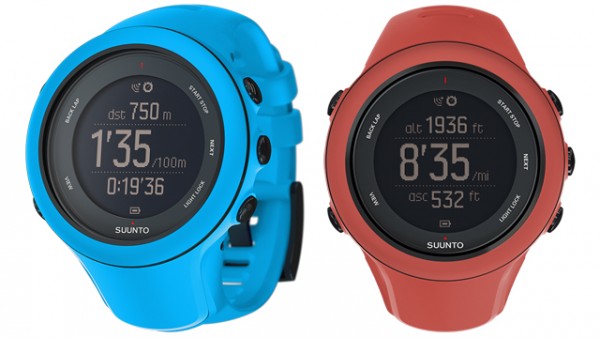
Here is our Suunto Ambit 3 Sport review.
Suunto Ambit 3 – Screen and Design
The most noticeable thing about the design of the Suunto Ambit 3 is how big it looks on the wrist. It has a size of 15.5mm and weighs 80g. This means that even when you compare it to other GPS watches out there, it’s still pretty bulky. Even on larger wrists, the GPS module will still be uncomfortable on the bones. On thinner wrists, it’s difficult to wear the watch comfortably because of its sheer size. The watch simply looks out of place on the wrist.
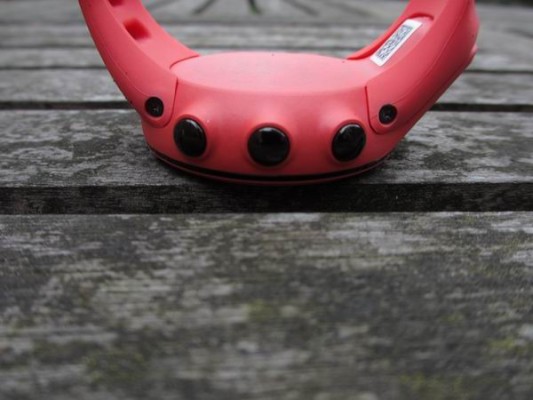
There are five buttons on the face of the watch – stop/start, light/lock, back/lap, next and view. Some can get pressed way too easily, even when on a soft run. This means that the lock option of the watch is very useful. There are four metal dots on the back of the watch that will snap in place the unusual USB cable. This means, however, that you will have to carry another cable that isn’t equipped with a standard plug.
The screen is a 128×128 one that takes up 29mm in diameter. However, not all of the display is being put to good use. The round design means that there is a lot of unused space on the screen. The display is recessed in the watch which means that it will get fewer knocks.
The display is pretty basic, just like on the Polar M400, but does have some useful graphs on it. It’s also bright enough for you to read out in the sunlight.

Suunto Ambit 3 – Features
The Suunto Ambit 3 comes in three different versions. The Ambit 3 Run is the cheapest one and doesn’t have cycling power and swimming heart rate functions and won’t allow you to change the sports while you are exercising. The Ambit 3 Peak is the most powerful of the three watches and features a doubled battery life and water resistance and also an air pressure sensor for reading better barometer, temperature and altimeter.
The Ambit 3 Sport is in the middle of the other two and combines heart rate, multi-sport GPS and other sensors decently with a 24 / 7 tracking of activities. Nevertheless, the general activity tracking function is standard, to put it mildly. All the versions of the Ambit 3 and the MovesCount app and site don’t feature kick out daily steps, for example. However, this thing could be improved by a potential update.
At the moment all that you will get from these watches is a general rating, a calorie count and a chart that shows your activity compared to previous days. The Ambit 3 doesn’t track the sleep at the time, which makes sense, seeing how the watch is uncomfortable and you won’t be able to wear it while sleeping.
The good thing is that the Ambit 3 scores a lot better on sport and exercise than on general movement and sleep. All you have to do is simply press the start button, choose the type of exercise you want and you’re good to go. The exercise you choose will determine how accurate the GPS will be, and thus how fast the battery will drain. This will also determine if the heart rate will be enabled or not, how many laps you should do and whether the GPS will be turned on or not altogether.
The GPS is enabled with the help of the nub (which is rather bulky) below the watch’s face and the heart rate is analyzed wirelessly with the help of a Bluetooth smart chest band. You should consider purchasing the separate Smart Sensor from Suunto which will come very handy. The Smart Sensor is the only band that is able to monitor the heart rate under water. Bluetooth can’t function in water so the strap will store the information while you are swimming. It will then sync the gathered data to the Ambit 3 once you get out of the water. But this means that you won’t have heart rate graphs on the screen while under water.
The alternative to this would be to make use of an optical heart rate monitor. This monitor is built into the watch and until now very few high-end watches have these kinds of optical sensors. They are usually used for analyzing the resting rate because of accuracy issues.
Just like the swimming heart rate, the Ambit 3 also scores high in its way of analyzing multi-sport events and outdoor activities. Turn by turn navigation is built into the watch, even when the watch is tracking an activity, along with a digital compass.
What’s more important for multi-sport users is that you will be able to change the activity in the middle of the exercise with only a few presses of buttons. You can also pre-set the order of sports and the periods of transitions and change between them with only a simple press of a button. For a triathlon you would have to set up swim, then transition, then bike, then transition again and finally run. One button press for every change will make sure the whole event is being tracked. The watch will track open water swims and pool activities in a different matter. The Ambit 3 will make use of the accelerometer info and the length of the preset to analyze laps in the pool automatically and it will use the GPS for open water activities.
The watch also has a feature that will allow you to set intervals of workouts with alarms, so you will be able to jog as a warm up, sprint at a specific heart-rate zone for a certain distance or time or a certain pace, then recover, start again, rest and so on. At the moment this can only be done with the app, but according to Suunto, the website feature will also be up and running soon.
Along this list of features, the watch also supports Bluetooth smart sensors beyond the heart rate. This means that the Ambit 3 supports even foot pods, even though the watch already measures, analyzing the movement of the wrist, things such as bike speed and pace. But the device also supports cadence and power sensors as well.
We tested the device paired with other Bluetooth smart products, like the Adidas foot pod and the Polar heart rate belt and they all functioned properly. However, you should be aware that there have been a few complaints regarding the somewhat poor functionality of the Ambit 3 when paired with certain Bluetooth smart sensors.
You can connect the Ambit 3 to your smartphone as well for data sync, but also to be able to get notifications on the display of the watch. Even though the simple data that is available on the watch may make Apple Watch users giggle, the fact is that if you wish for a basic icon to inform you when you get an e-mail or a Twitter mention, this can be done on the watch.
Suunto Ambit 3 – App
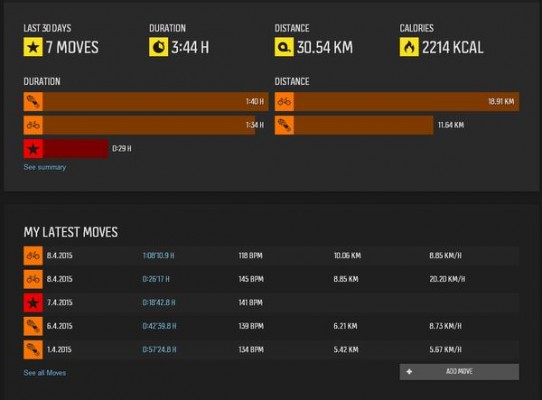
Like its rivals, Garmin and Pole, Suunto really needs to take a look at what Fitbit and other manufacturers are doing with their companion apps. When compared to those apps, the app by Suunto is extremely basic.
MovesCount tries to copy the desktop website MovesCount and only adds the capability to program workouts intervals. The companion app is currently available only on iOS but support for Android was promised from the 4.3 version onwards. This means that most Android users will get the chance to use the app as well.
As far as the app and the desktop version go, it will allow you to track and analyze your activities (or Moves) in great detail. Zones and training effects, heart-rate charts and maps are all available in the app as well as recovery time, VO2, calories and other esoteric information.
What the app is missing is the general information of fitness such as any goals to work towards and steps per day. There is also a general lack of over-time tracking information and encouragement to use social interactions.
You are able to see other members with the help of the app in your area, see their respective “Moves” and even join groups. But there isn’t much friendly competition or community spirit available in the app. For example, at the time there isn’t a Birmingham group and even the biggest group in London only has 13 members. The London Marathon only has a mere 15 people in the event.
There is at least an easy automatic sync to Strava and this is an option that is really simple to set up. There are multiple formats available for export such as TCX and GPX for other communities of fitness.
One thing is great about the app from Suunto, though, the fact that its watches are opened for third party developers. There are numerous apps that can be downloaded and installed on the Ambit 3. For example, there is a third party app that will display your heart rate in the form of a percentage of maximum or show you an estimated time that remains to 10k.
Suunto Ambit 3 – Setup
Operating and setting up the Suunto Ambit 3 is very easy to do. There is a very simple sign-in process on the watch, with more data that can be inputted with the help of the website or the app, to generate heart-rate zones. After you do this, you’re all set to go.
This is all you need to do, unless you want to get into more complex matters of workout intervals, display types and custom exercises. The desktop software, even though it’s not as well designed as some others, is still pretty easy to use and to set up. Pairing with other devices and belt setup is just as easy to do. Menus on the Ambit 3 are very clear and simple as well.
Suunto Ambit 3 – Performance
Because Suunto has a long heritage in heart rate monitoring and GPS, there’s no wonder that everything works just as it should do. The GPS in the Ambit 3 does take a little more time to get your location when compared to the Polar M400, but this isn’t such a big deal as the difference is only by a few seconds. The heart rate monitor is very reliable and got a fix pretty quickly.
There have been some complaints online regarding the heart rate strap moving during turns in swimming races, but I didn’t face this problem to be completely honest. The GPS is far less accurate in water, however, but this is because the GPS signals don’t work all that properly underwater. GPS won’t work at all when diving.
All in all, the performance was quite excellent. The real problem of the Suunto Ambit 3 is its shape and size. The watch is very bulky and it really doesn’t work as a simple fitness band because you can’t forget that you are wearing it at all.
Suunto Ambit 3 – Battery Life
The Ambit 3 claims to have a 14 day basic use battery life or a 15 hour battery life when used with GPS at five second intervals. This is pretty accurate when compared to real life testing.
The Ambit 3 didn’t require to be recharged for many days when used with heavy sport activities such as three days of running, rowing and a couple of bike rides that totaled to about three hours of constant activity.
Should I buy the Suunto Ambit 3?
The answer is a definite yes if you are a multi-sport user. However, if you wish to combine a general fitness band to accurate tracking of your activities, then the answer is no.
For the latter use, you will find yourself easily annoyed by constantly wearing the Ambit 3 and this will also tire you up pretty quickly. The general activity information on the Ambit 3 is at the moment far too inaccurate as well. For this approach, you’d be better off buying the Polar M400.
The Ambit 3 could prove to be a great purchase if you’re more interested in tracking numerous sports, especially if any of those sports are water based. It has an impressive feature list and the watch performs very well, which makes it a good value.
That being said, the Polar V800 has a somewhat similar price and also features multi-sport and swimming support. The Polar V800 also works a lot better tracking general activity and the Ambit 3 pretty much fails in that department. It’s also a lot slimmer and not as obtrusive. Because of these reasons, The Polar V800 might be a better deal.
Wrapping up…
Suunto Ambit 3 – Key Features
- GPS activity tracking
- Daily activity fitness tracker
- Wireless heart-rate monitoring which also includes swimming activities tracking
- Bluetooth smart foot pod and other sensors support
- Multi-sport support including times of transition
- 80g weight
- 15.5mm thick by 50mm diameter body
- 50m water resistant
- 10 hour minimum battery life
- 14 day battery life for fitness tracking only
PROS
– Navigation and multi-sport support
– Tracks your heart-rate while you swim
– Tracks heart-rate, daily activities and GPS
CONS
– Pricey when being compared to other similar products
– Daily fitness summary isn’t very detailed
– Very uncomfortable and bulky on the wrist
Conclusion
The Suunto Ambit 3 is a great heart-rate monitoring, multi-sport GPS watch but for other general activity tracking, many rival sports watches and fitness bands do the job better.



