While a large portion of the focus of NASA is currently going towards the ‘Journey to Mars’ mission and its prerequisites, the space objects beyond the Red Planet remain an intriguing study topic as well. One such fascinating subject of discussion for scientists is the dwarf planet Ceres that lies just between the orbits of Mars and Jupiter and is considered the largest object in the asteroid belt.
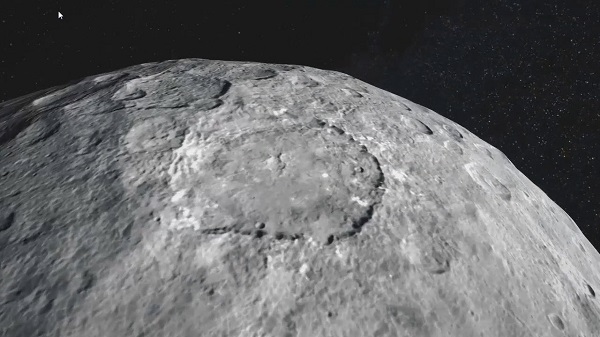
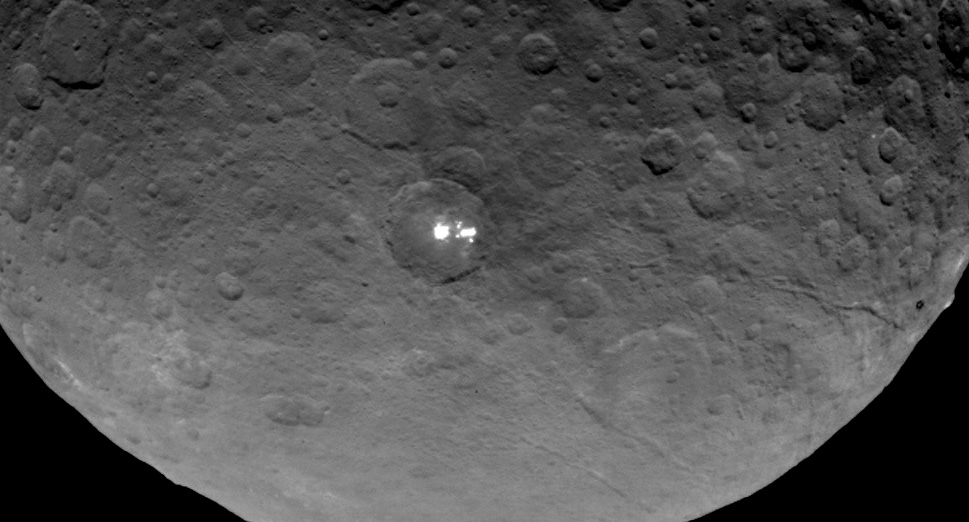
At only 945 kilometers in diameter, Ceres could appear a very dull dwarf planet, displaying nothing more than a battered gray surface, with dozens of craters left by impacts with various meteorites. But on a closer inspection of some of the craters left by such impacts, one can notice that the small planet displays some bright spots inside these craters that were not that visible until the Dawn probe managed to capture a few ‘close-ups’ of the planet’s surface.
Ceres is believed to have a rocky core and icy mantle, as well as what is suspected to be an internal ocean of liquid water. Previous to the Dawn probe’s arrival close enough to the dwarf planet in order to study it, it fell down onto the Hubble Space Telescope to study its surface. But given the long distance and the very small size of Ceres, not much was achieved other than detecting a variation on the surface. Surprisingly, this variation was detected right where the Dawn probe later spotted the bright spots.
It was eventually concluded, thanks to the images that the Dawn probe was able to capture, that the spots are most likely made of hydrated magnesium sulfates. In earthlier terms, these are very similar to bath salts. Prolonged study of these bright spots revealed that the icy materials in and around the shiny, bright spots may be turning straight into vapor when they are hit and heated by sunlight.
This is a discovery that was made by comparing the different reflectivity levels displayed. Vapor will reflect sunlight differently than solid ice does. The two bright spots located in the 80-kilometer-wide crater called Occator were revealed to be a conglomerate of what appears to be as many as ten different spots. Scientists believe that these spots freeze at night and evaporate within direct sunlight, but certain differences and a lack of perfect cyclicity of this process does anything but confirm this hypothesis.
Researchers are currently devising a method of continuing their study on these bright spots of Ceres through means that can be employed from the surface of the Earth.
Image Source: 1