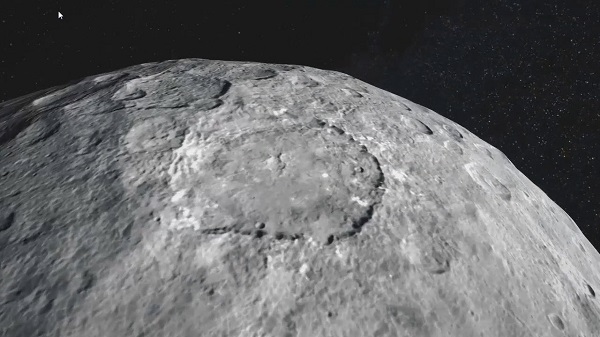
Just earlier last week, a new animation was released, depicting the way NASA imagines a flight over Ceres in a computer rendered video. This does not mean that the stunning images you can see in the video are any less than realistic.
In the absence of real life footage – at least in the way the public expects it – NASA has always been known to find the most exquisite ways of showing the workings on the universe. While close shots of the surface of our own planet depict the way the city lights and planetary magnetic field graze the Earth and look like form outer space, more distant celestial bodies in our solar system aren’t as easy to immortalize.
While satellites and probes can only show us so much information about the way things look from the big black void out there, the result is rarely clear enough to serve as an entire mapping of the studied object.
And out of all the places that are within reach of mankind in our own solar system, the Asteroid Belt is most likely one of the most unsafe ones – especially for unmanned spacecrafts. The NASA mission that lasted from August to October 2015 and employed the numerous cameras and sensors mounted on the Dawn spacecraft. Throughout the 3 months, Dawn’s framing camera team situated on Earth, at the German Aerospace Center (DLR), worked to create an accurate 3D mapping of the surface of Ceres.
Ceres is a dwarf planet and yet considered the largest body that can be found in the asteroid belt that rests between the orbits of Mars and Jupiter. Made of rock and ice, the planet is believed to have remnants of liquid water in an entire internal ocean, deep underneath the outer layer of ice. Because of the presence of ammonia in its outer composition, it is believed that Ceres originated from much further away – the Kuiper belt that rests on the outer edge of our solar system.
The video released by NASA depicts the many craters that the surface of Ceres keeps as a reminder of the rough conditions of our solar system’s asteroid belt. The movie depicts the planet in color – something that real footage is not common to have – in order to highlight the different materials that can be found in the surface. This is a mere example of the mystery surrounding the dwarf planet as scientists are amazingly intrigued by the potential of Ceres of being one of the place where life may have – at one point – existed in microbial form.
Image Source: 1