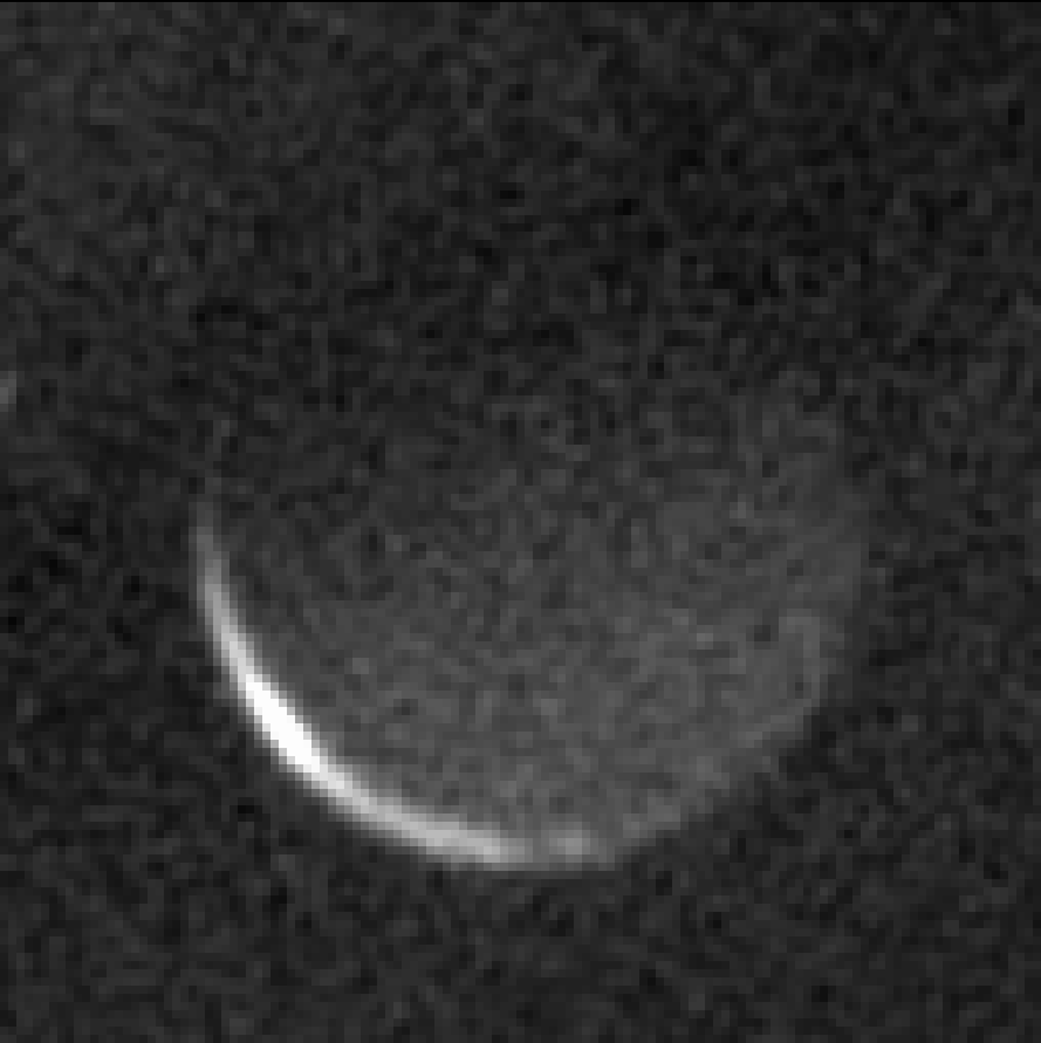
NASA releases photos of Charon taken by New Horizons space shuttle and they depict the very dark and yet very beautiful nature of Pluto’s largest moon. The images were captures on July 17th during the 3 day long flyby of the probe as it was moving past Pluto. A total of 16 one-second exposure photos were taken using the shuttle’s Long Range Reconnaissance Orbiter from a whopping distance of 1.9 million miles even though New Horizons came as close as 7,800 miles from the surface of Pluto.
The images captured depict the night side of Charon, only distinguishable as it’s dimly lit by the light reflected off of the surface of Pluto and yet still shows just how battered and scarred the surface of the moon is. Graced by cryogeysers and cryovolcanoes, Charon is the largest and probably harshest of Pluto’s total of 5 moons.
The pictures that were taken have actually witnessed the south pole of Charon. This zone entered polar night all the way back in 1989 and is expected to last until 2107, when sunlight will be shed again on that side of the moon. Charon’s harsh ‘winter’ conditions makes up for temperatures nearly as low as absolute zero – minus 459.67 degrees Fahrenheit, which is believed to be the point where atoms stop moving.
The images taken this way are extremely rare and valuable as the New Horizons probe continues its trek past the far edges of our solar system and hoping to do a flyby of a small object dubbed KBO 2014 MU69 which can be found nearly 1 billion miles beyond Pluto. This is nearly a quarter of the distance between Earth and Pluto. The shuttle is expected to fly past it by January 1st of 2019.
For many years, Pluto and its moons have remained covered in mystery until the probe that was launched in 2006 made the entire trek all the way to the far end of the solar system to reveal a huge amount of information about the dwarf planet’s surface and composition as well as its tiny moons. Charon has a diameter of around 753 miles, exceeding by far the size of all of the other four – Nix, Hydra, Kerberos and Styx. For example Hydra is 27 miles in its longest direction.
However, this may not be the last thing we see until the shuttle reaches its next destination as data is constantly being fed to the surface of the Earth by the probe, and images depicting the edge of the solar system will continue coming in until October this year.
Image Source: 1

Latest posts by Nancy Young (see all)
- Missouri Man Robbed by Date and Accomplice in Park - June 22, 2018
- Bose Poised to Launch Sleepbuds, In-Ear Headphones That Help You Sleep - June 21, 2018
- Russia Is Developing a Space Debris Laser to Keep Space Clean - June 15, 2018