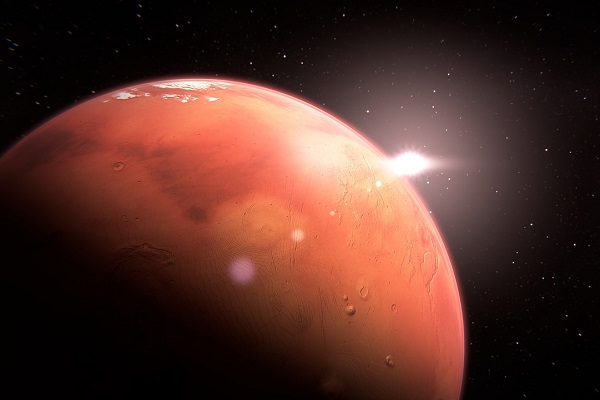
Scientists are reconsidering the giant impact hypothesis that was universally agreed on in 2001 as the favored way in which our planet’s moon was formed. The original theory that suggested that a foreign planet with the body size of Mars known as Theia or Orpheus had collided into the side of planet Earth somewhere nearly 4.5 billion years ago. The debris and particles that were created as a result drifted under the Earth’s gravitational pull for a while until they coalesced into what we know as the Moon today.
While the thesis was supported by a great amount of evidence and scientists even managed to simulate what a collision such as that one would’ve looked like and how the moon was eventually formed, recent study suggests that while there’s very little doubt that an Orpheus once existed, the collision may not have happened the way it was imagined until now.
Scientists have been studying oxygen isotopes form the moon rocks taken by the rovers of the Apollo missions, with the basis that each planet has its personal oxygen signature, differentiated by various degrees from one another. According to that theory, if the Earth’s moon was indeed made up mostly of the remnants of Orpheus, then our natural satellite should have a different oxygen signature than our planet.
Turns out that the oxygen isotopes of both Earth and the Moon are near identical, which would instead suggest that the latter could rather be considered a piece of the Hadean-era Earth. That is why the new theory suggests that Orpheus didn’t just side-swipe the Earth, but instead had a head-on collision with the planet and got incorporated in it in the process.
If that is truly the case, then it would explain how both Earth and the Moon have the same oxygen signature. When Orpheus got swallowed into the Earth, particles and debris of both planets were spewed out of the host planet’s atmosphere which slowly coalesced, giving both bodies the same signature.
On top of that it is believed that Theia (Orpheus) was actually a growing planet at the time of impact, a theory that actually eases the belief that the two fused instead of side-swiping each other in order to create the moon.
Image Source: 1