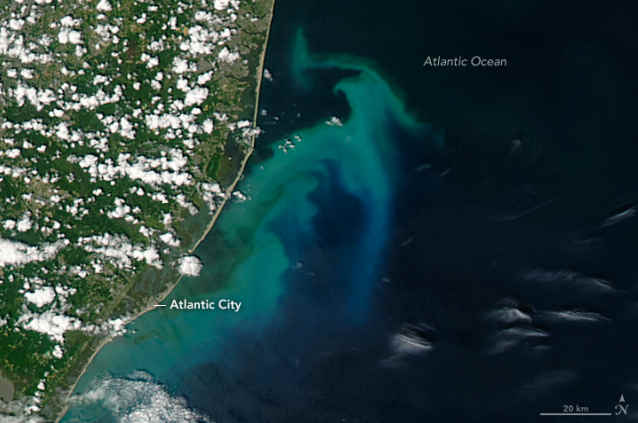
Satellite view of NJ coastal waters on July 7. Image Credit: Jeff Schmaltz/NASA
Beachgoers are startled by the unusual change in ocean water along the South Jersey shoreline. Usually, coastal waters in the area are of murky grayish color, but this time waters have gained a much tropical tint that makes them resemble the Carribbean.
Tourists noted that waters are also so clear that they can spot details they haven’t been able to do such as enjoying the sight of dolphins.
Scientists explained that a fresh influx of cold ocean water earlier this month has prompted coastal microalgae to bloom off. So waters borrowed the greenish hue of the chlorophyll in the aquatic plants.
However, algal bloom does not explain why the waters are so transparent during this time of the year. Researchers have another hypothesis: a prolonged drought in the Northeast seems to be the culprit.
Some business owners operating ocean excursions said that they have been on the waters their entire lives, but they weren’t able to recall a time when the water looked so tropical and clear. Cruise operators said that tourists are very impressed with the curious phenomenon since they can now easily spot dolphins even at several feet below the waves.
Yet, beachgoers and tourists alike are the most puzzled with the green waters. Marine scientists explained that marine upwelling has led to an explosion in the growth of phytoplankton along the Jersey shoreline.
Phytoplankton are microscopic plants which thrive when they are inundated with nutrient-rich waters coming from the colder subsurface layers down below. Researchers explained that the tiny plants are as small as a dot made by a pencil on a sheet of paper and they cannot be observed without a microscope. Yet, when they bloom so explosively, their presence cannot be missed.
Scientists said that the greenish hue of the waters is due to the chlorophyll in the marine plants. When sunlight reaches the plants, chlorophyll emits aquamarine wavelenghts through the ocean waters.
Biologists noted that there are billions of microscopic plants within the algal bloom. In a small soda can, you can fit about 500,000 microscopic plants.
Authorities reassured beachgoers that the microalgae are not a threat to their health. In fact, the plants are essential for the ocean ecosystem as they provide a rich source of food for many marine animals.
Image Source: NASA

Latest posts by Nancy Young (see all)
- Missouri Man Robbed by Date and Accomplice in Park - June 22, 2018
- Bose Poised to Launch Sleepbuds, In-Ear Headphones That Help You Sleep - June 21, 2018
- Russia Is Developing a Space Debris Laser to Keep Space Clean - June 15, 2018