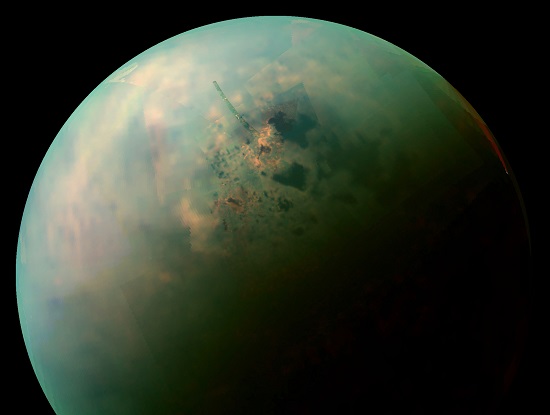
 The data beamed back by NASA’s Cassini probe in May 2013 enabled scientists solve another puzzle linked to Saturn’s largest moon Titan. Researchers believe that they know what the mystery ‘dark material’ in the canyons may be.
Previous imagery has revealed that the moon’s canyons contain a dark liquid that in some places sits at sea level while in others is hundreds of feet higher. A recent study suggests that the web of canyons that branches out from Ligeia Mare is filled with liquid methane. Ligeia Mare is a liquid methane lake located in the northern polar region of Titan.
The imagery is the first evidence of methane rivers in the moon’s dark canyons and the first view of thousands of feet deep channels. For instance, one web of canyons called Vid Flumina is up to 1,870 foot deep.
Cassini images were taken by the probe during its 2013 flyby. Back then, the tiny spacecraft focused its scientific instruments on Titan’s vast network of channels that stems from the moon’s second largest methane lake, Ligeia Mare.
Prior to this analysis, scientists have thought that the darkish regions in the moon’s canyons were either a mystery liquid or frozen sediment. But during the 2013 flyby, Cassini analyzed the canyons with microwaves, which indicated that the dark areas were incredibly smooth just like the methane lakes.
Additionally, radar-based technology helped Cassini mission scientists approximate the depth of the moon’s canyons.
Nevertheless, the team cannot yet tell how these steep canyons emerged. Researchers only know that it either took a lot of time for the channels to form or the erosion processes were accelerated in channels’ area.
Other hypotheses include a sudden raising in the altitude of the moon’s surface or shifts in methane lake’s levels. Yet, both scenarios might have happened simultaneously too. On Earth, for example, the Grand Canyon appeared in the wake of a terrain uplift which forced water to cut deeper into the rock.
Lead author of the study Valerio Poggiali who is an associate radar expert involved in the mission explained that there was a “combination of forces” that created the channels, but his team cannot tell how much each force has contributed.
Poggialy’s team now expects that future theories on the moon’s geological history will also explain its canyons’ formation.
Image Source: Wikimedia

Latest posts by Nancy Young (see all)
- Missouri Man Robbed by Date and Accomplice in Park - June 22, 2018
- Bose Poised to Launch Sleepbuds, In-Ear Headphones That Help You Sleep - June 21, 2018
- Russia Is Developing a Space Debris Laser to Keep Space Clean - June 15, 2018