Researchers have developed a cheap paper centrifuge from an ancient toy.
Centrifuges are an essential tool for doctors, labs and research centers across the world. However, despite their many benefits, they are quite expensive, quite large and require electricity to function. Such requirement cannot be met in poorly developed regions where doctors need them the most.
However, the future of centrifuges is looking a lot better thanks to the amazing invention of a team of researchers from Stanford University. Taking direct inspiration from a whirligig toy for children, the researchers were able to create a paper centrifuge which can be spun by hand without any need for electricity, a precious commodity in undeveloped regions.
Furthermore, the device is also extremely cheap, costing only 27 cents to make, and provides results quite fast compared to a normal centrifuge, as it is able to detect diseases like malaria in blood in only 15 minutes.
Researchers across the world recognize the importance of centrifuges and a bid to overcome its limitations, they tried to develop simple and less expensive devices from kitchen instruments like egg beaters or salad spinners. However, none were successful as they did not reach the required speeds specific to an advanced centrifuge.
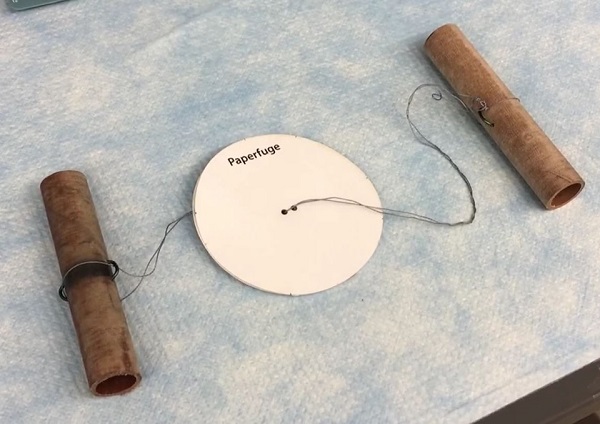
The new paper centrifuge developed by Manu Prakash and his colleagues from Stanford was detailed in a paper published in the journal Nature Biomedical Engineering. They were able to recreate the capabilities of a modern centrifuge by using paper and wire while being lightweight, low-cost, and human-powered.
The scientists decided to name their paper centrifuge invention the “paperfuge”, which is able to reach an astonishing speed of 125,00 revolutions per minute. It can exert centrifugal forces of around 30,000g. This allows its users to separate white and red cells in a blood sample introduced into its paper core in only a few minutes of usage.
The paperfuge is the fastest non-electrical centrifuge ever developed, being 100 times faster than any previous inventions and it’s considered to have the highest rotational speed for a human-powered device. The inspiration for the device comes from an ancient toy known as the whirligig, dating back to 3.300 BC. It works by pulling the strings which pass through the center of the paper disk which can hold different medical samples. Pulling on the handles connected to the strings unwinds them making the disc rotate at high speeds.
Image credit: Stanford

Roxanne Briean
Latest posts by Roxanne Briean (see all)
- Former Virginia Tech Freshman Sentenced to 50 Years in Prison for Stabbing a Girl to Death - June 28, 2018
- San Francisco Woman Threatened to Call Police on Girl Who Sold Ice Water for Disneyland Trip - June 25, 2018
- Epping Woman Sentence to 20 Years of Prison for Mutilating Homeless Woman’s Children - June 12, 2018