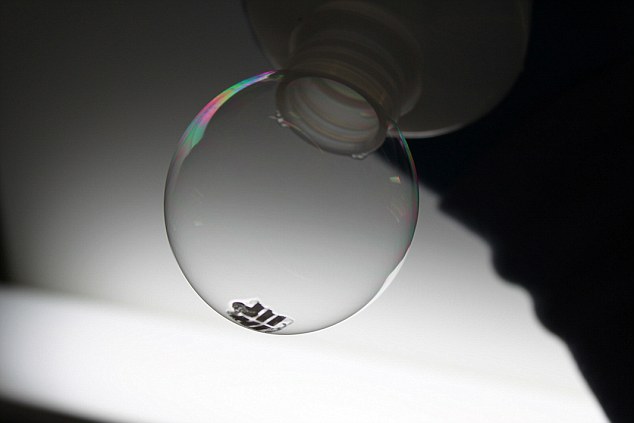
A number of scientists from MIT are behind the solar panels that can rest on a soap bubble that have been announced for the first time several days ago. While the whole ‘resting on a soap bubble’ technology catchphrase may feel like it’s been overused, it is merely because the new solar panels are so small, thin, light and flexible that they were literally shown as they were set down on a huge soap bubble that didn’t burst when that happened.
The very way it’s constructed provides for more than just being extremely light; because it was made with the idea of building it as a whole piece, with both the substrate and the overcoating being produced under the motions of the same process and using the same type of materials, the new tiny solar panel manages to achieve many. Both parts are made from a flexible polymer known as parylene – something that is also used as a protective material in biomedical devices and circuit boards – and the final, light-absorbing outer layer is made of DBP.
Because of that, the substrate will never require cleaning or tampering with, without losing any performance potential, while the light-absorbing surface has demonstrated an amazing amount of light-capture, at least when compared to the sheer size that it comes in. Naturally, the concept behind this new type of solar panels has just been presented by researchers at MIT in a paper published in the gournal Organic Electronics by Vladimir Bulović, Annie Wang and Joel Jean.
The team that worked on these solar panels insists that the materials used were mere examples of how the application of the concept should be used, and that the process of building the panels as part of the same whole is the concept that should be used in order to apply the construction at a larger scale.
The researchers also mentioned that the example they provided is much too thin and small for practical use, but a good demonstration of how it can be achieved even at extremely small scales when an 80 micron thick parylene film is used in the construction. However, if the same type of process is used with different materials, such constructed solar panels could easily be the next method of powering up space crafts or other, much heavier types of machinery, without ever needing to tend to it or the risk of environmental factors diminishing its power of capturing solar light.
Image Source: 1