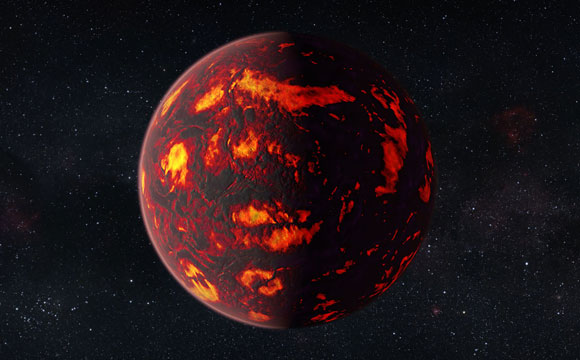
The mere capabilities of space observation tools these days has become truly outstanding as proved recently – the Hubble Space Telescope detected the composition of super earth atmosphere. The telescope studied a particular super earth known as 55 Cancri e, also called Janssen.
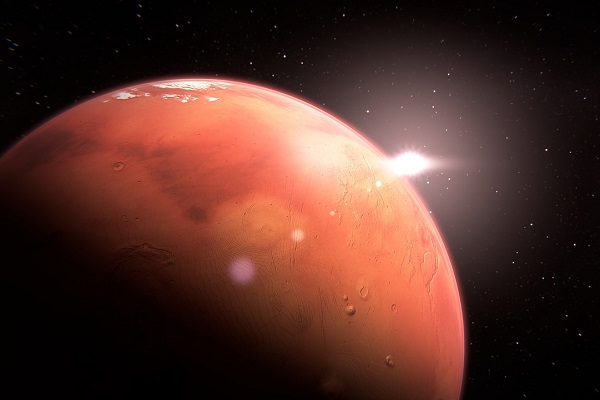
55 Cancri e is an extrasolar planet that orbits Copernicus, a G-type star 41 light years away from the Earth. In terms of astronomic distances, this counts as close to our own solar system, but still unfeasibly far away from human or probe travel at the current time. 55 Cancri e is called a super earth because It is larger than our very own Earth, but its mass remains smaller than the ones found on gas giants in a solar system.
Which is what makes the fact that the Hubble Space Telescope was able to not just spot it, but also thoroughly study it and the composition of its atmosphere. 55 Cancri e is a planet that lies very close to its sun, resulting in a temperature that goes up to 3,600 degrees Fahrenheit (2,000 degrees Celsius).
By applying a new method of observation and analysis, the Hubble Spacce Telescope was able to look closely at what the atmosphere of this planet is like, in hopes of understanding and expanding the knowledge we have on super earths across the Milky Way. This is an important study as it’s believed that super earths are the most often found type of planet in our galaxy. Now that a characterization of this type of planet has been made, researchers can understand better what they should be looking for when studying other planets.
55 Cancri e is a very exotic example of a super earth regardless, and most likely one of the most inhospitable scenarios to begin with. Because it’s orbiting so close to its host star, it completes one orbit every 18 hours. Scientists have detected that its atmosphere is mostly comprised of hydrogen and helium, extremely dry with no indications of any water vapors. Although it was originally believed that 55 Cancri e had an interior heavily consisting of carbon, gaining the title of a possible ‘diamond planet’. After the most recent studies, however, it was detected that the core may not be as carbon-rich as previously thought, but instead the atmosphere proved to contain hydrogen cyanide instead.
Given these discoveries as they were made thanks to the Hubble Space Telescope, scientists can now understand the way the planet evolved and they took the chance to express the surprise at seeing at how much of its primordial gas atmosphere the 55 Cancri e super earth has retained.
Researchers will certainly continue to apply this new analysis technique on other smaller, cooler planets that the telescope can pick up on in search for more knowledge of alien planets.
Image Source: 1

Michael Turner